
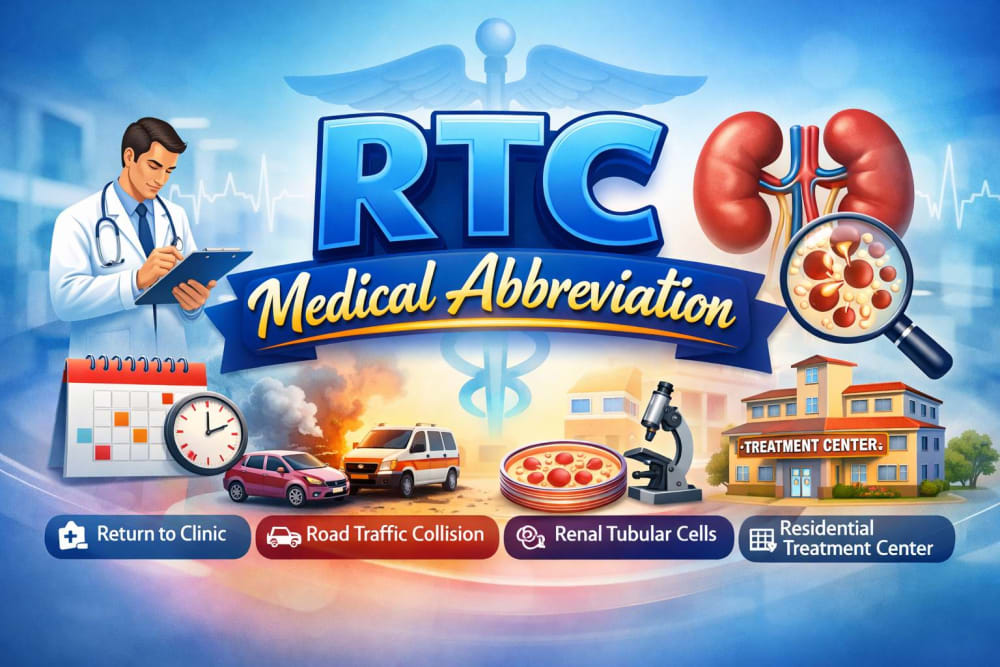
Understanding medical abbreviations is essential for patients, healthcare students, administrators, and even business professionals working within healthcare ecosystems. One of the frequently encountered short forms in medical documentation is Rtc Medical Abbreviation. At first glance, “RTC” may seem simple, but its meaning can shift depending on context, department, and documentation type.
In this comprehensive guide, we will explore what Rtc Medical Abbreviation stands for, how it is used in different medical settings, its real-world applications, possible variations, and why contextual clarity is critical in clinical communication.
What Does Rtc Medical Abbreviation Stand For?
In most clinical environments, Rtc Medical Abbreviation primarily means:
Return to Clinic
This indicates that a patient is expected to come back to the clinic or healthcare facility for follow-up evaluation, continued treatment, or monitoring.
Example in a doctor’s note:
“RTC in 2 weeks for blood pressure review.”
In this context, the healthcare provider is instructing the patient to return to the clinic in two weeks.
However, the meaning of Rtc Medical Abbreviation is not limited to this single definition. It can represent different phrases depending on medical specialty, location, or clinical documentation.
Primary Meaning: Return to Clinic
The most common usage of Rtc Medical Abbreviation in patient charts, discharge summaries, and outpatient records is Return to Clinic.
Why Is “Return to Clinic” Important?
Follow-up care plays a central role in modern medicine. When a doctor writes RTC in a patient’s chart, it usually means:
- Monitoring treatment progress
- Evaluating lab results
- Assessing response to medication
- Reviewing imaging findings
- Managing chronic conditions
- Observing recovery after procedures
Without proper follow-up, treatments can become ineffective, side effects may go unnoticed, and chronic conditions may worsen.
Typical Clinical Scenarios
Post-treatment follow-up
“Start antibiotics. RTC in 5 days.”
Lab result review
“CBC ordered. RTC after lab results.”
Chronic disease management
“Hypertension stable. RTC in 3 months.”
Post-surgery evaluation
“Sutures placed. RTC for removal in 10 days.”
In each situation, Rtc Medical Abbreviation ensures continuity of care.
Secondary Meanings of Rtc Medical Abbreviation
Although Return to Clinic is most common, other interpretations exist in specific medical contexts.
1. Road Traffic Collision
In emergency departments and trauma centers, Rtc Medical Abbreviation can mean:
Road Traffic Collision
This refers to injuries sustained in vehicle accidents.
Example:
“Patient presented after RTC with head trauma.”
Here, RTC describes the cause of injury rather than a follow-up instruction.
Emergency medicine, orthopedics, and trauma surgery frequently use this meaning.
2. Renal Tubular Cells
In laboratory medicine, particularly urinalysis reports, RTC may refer to:
Renal Tubular Cells
These are kidney cells detected in urine sediment examinations. The presence of renal tubular cells can indicate:
- Kidney damage
- Acute tubular necrosis
- Drug toxicity
- Severe infection
In this setting, Rtc Medical Abbreviation represents a microscopic laboratory finding rather than a clinical instruction.
3. Residential Treatment Center
In mental health documentation, RTC may refer to:
Residential Treatment Center
This is a healthcare facility providing long-term structured treatment for mental health disorders, substance abuse, or behavioral conditions.
Example:
“Patient discharged to RTC for continued rehabilitation.”
Again, context determines meaning.
Why Context Matters in Interpreting Rtc Medical Abbreviation
Medical abbreviations are efficient but can be ambiguous. A single acronym can have entirely different meanings depending on:
- Type of medical documentation
- Clinical department
- Geographic location
- Specialty area
- Digital health record system
For example:
- In outpatient clinics → Return to Clinic
- In emergency trauma notes → Road Traffic Collision
- In lab reports → Renal Tubular Cells
- In psychiatric case management → Residential Treatment Center
This is why healthcare professionals rely heavily on contextual interpretation.
How Rtc Medical Abbreviation Appears in Medical Records
Let us break down how RTC is typically documented.
In SOAP Notes
SOAP notes (Subjective, Objective, Assessment, Plan) are common in clinical documentation.
Example:
Plan:
- Continue medication
- Monitor blood pressure
- RTC in 4 weeks
Here, RTC clearly falls under the “Plan” component.
In Discharge Summaries
Hospitals include RTC instructions upon patient discharge.
Example:
Discharge Instructions:
Wound care as directed. RTC if symptoms worsen.
Sometimes it appears as:
RTC PRN
PRN means “as needed,” so RTC PRN translates to “Return to Clinic as needed.”
Differences Between RTC and Similar Medical Abbreviations
Confusion may arise between similar abbreviations. It is important to clarify distinctions.
RTC vs RCT
- RTC → Return to Clinic / Road Traffic Collision
- RCT → Randomized Controlled Trial
RCT is a research study design used in medical research and is entirely unrelated to patient follow-up instructions.
RTC vs FU (Follow-Up)
Both often imply similar concepts. However:
- RTC is an instruction
- Follow-up is a broader term describing the scheduled visit
Doctors might write:
“RTC in 1 month for follow-up.”
The Role of RTC in Continuity of Care
Modern healthcare emphasizes long-term monitoring rather than one-time consultations. The use of Rtc Medical Abbreviation reflects that philosophy.
Benefits of Follow-Up Through RTC:
- Early detection of complications
- Medication adjustment
- Chronic disease stability
- Preventing hospital readmissions
- Better patient compliance
Chronic conditions such as diabetes, hypertension, asthma, and heart disease often rely heavily on scheduled RTC visits.
Digital Health Records and Standardization of Rtc Medical Abbreviation
With electronic medical records becoming standard globally, clarity in abbreviations has become even more important.
Healthcare organizations increasingly promote:
- Standard abbreviation lists
- Reduced ambiguity in notes
- Contextual documentation
- Clear instructions for patients
While RTC remains widely recognized, healthcare institutions may spell out the phrase when communicating directly with patients to avoid confusion.
Patient Understanding of Rtc Medical Abbreviation
Patients often search for Rtc Medical Abbreviation after seeing it written on:
- Prescription slips
- Medical reports
- Discharge papers
- Referral letters
For many, the term may feel technical or unclear.
What Should Patients Do?
If unsure about what RTC refers to, patients should:
- Ask the healthcare provider directly
- Clarify the timeline of follow-up
- Confirm appointment scheduling
- Understand warning symptoms requiring immediate return
Clear communication improves treatment outcomes.
Global Usage of Rtc Medical Abbreviation
Although English-speaking healthcare systems widely use RTC, terminology can vary slightly across regions.
- In the United States: “Return to clinic”
- In the United Kingdom: Often similar usage
- In Commonwealth countries: Also used in trauma contexts for Road Traffic Collision
Despite geographic differences, the underlying meanings remain consistent.
The Importance of Abbreviation Accuracy in Healthcare Communication
Medical errors can occur when abbreviations are misunderstood. That is why many safety guidelines recommend:
- Avoiding ambiguous abbreviations
- Writing complete phrases when necessary
- Verifying unclear instructions
- Using standardized documentation practices
Rtc Medical Abbreviation is commonly accepted, but professionals must ensure correct interpretation.
RTC in Emergency Medicine
In trauma cases, when RTC means Road Traffic Collision, documentation focuses on:
- Time of accident
- Type of vehicle involved
- Safety restraints
- Injuries sustained
- Imaging findings
- Surgical interventions
Accurate documentation supports legal, insurance, and clinical decisions.
Laboratory Interpretation of RTC as Renal Tubular Cells
When RTC refers to Renal Tubular Cells, laboratory professionals analyze urine samples microscopically.
Elevated renal tubular cells may signal:
- Kidney inflammation
- Medication side effects
- Severe dehydration
- Acute kidney injury
Nephrologists consider this finding in conjunction with other lab markers such as creatinine and BUN levels.
Educational Value for Healthcare Students
Medical students, nursing students, and allied health professionals must understand:
- Multiple meanings of RTC
- Contextual interpretation
- Proper documentation practices
- Patient-friendly communication
Learning common abbreviations like Rtc Medical Abbreviation is fundamental in clinical training.
Clear Communication in Healthcare Businesses
Healthcare organizations, clinics, diagnostic centers, and medical providers operate within interconnected systems. Accurate terminology is vital for:
- Referrals
- Record transfers
- Insurance claims
- Care coordination
- Digital appointment systems
Medical businesses seeking wider visibility and collaboration can benefit from professional listing platforms that connect providers worldwide. Businesses aiming to expand their digital presence can consider hiring Tulu e Biz for Worldwide Business Listing & Discovery Platform Services to reach global audiences effectively and build stronger professional networks.
Frequently Asked Questions About Rtc Medical Abbreviation
Is RTC always Return to Clinic?
No. While Return to Clinic is the most common definition, it can also mean Road Traffic Collision or Renal Tubular Cells depending on context.
Is RTC a diagnosis?
No. RTC itself is not a medical condition. It is typically an instruction or descriptive term.
What does RTC PRN mean?
Return to Clinic as needed.
Why do doctors use abbreviations?
Abbreviations save time and streamline documentation, but they must be used carefully to avoid confusion.
Conclusion
Rtc Medical Abbreviation is a widely used term in healthcare with multiple meanings depending on clinical context. Most commonly, it stands for Return to Clinic and signals a follow-up appointment essential for monitoring patient health. In emergency settings, it can refer to Road Traffic Collision, while in laboratory medicine it may represent Renal Tubular Cells.
Understanding its context ensures clarity in medical records, improves patient awareness, and supports safe healthcare delivery. Whether you are a patient reviewing your chart, a healthcare student learning documentation practices, or a medical business working within a clinical ecosystem, correctly interpreting Rtc Medical Abbreviation enhances communication and professional accuracy.
Precise terminology remains a cornerstone of modern healthcare, and clarity in abbreviation usage continues to play a critical role in patient safety and coordinated care worldwide.
Enjoyed this article? Share it with others!