
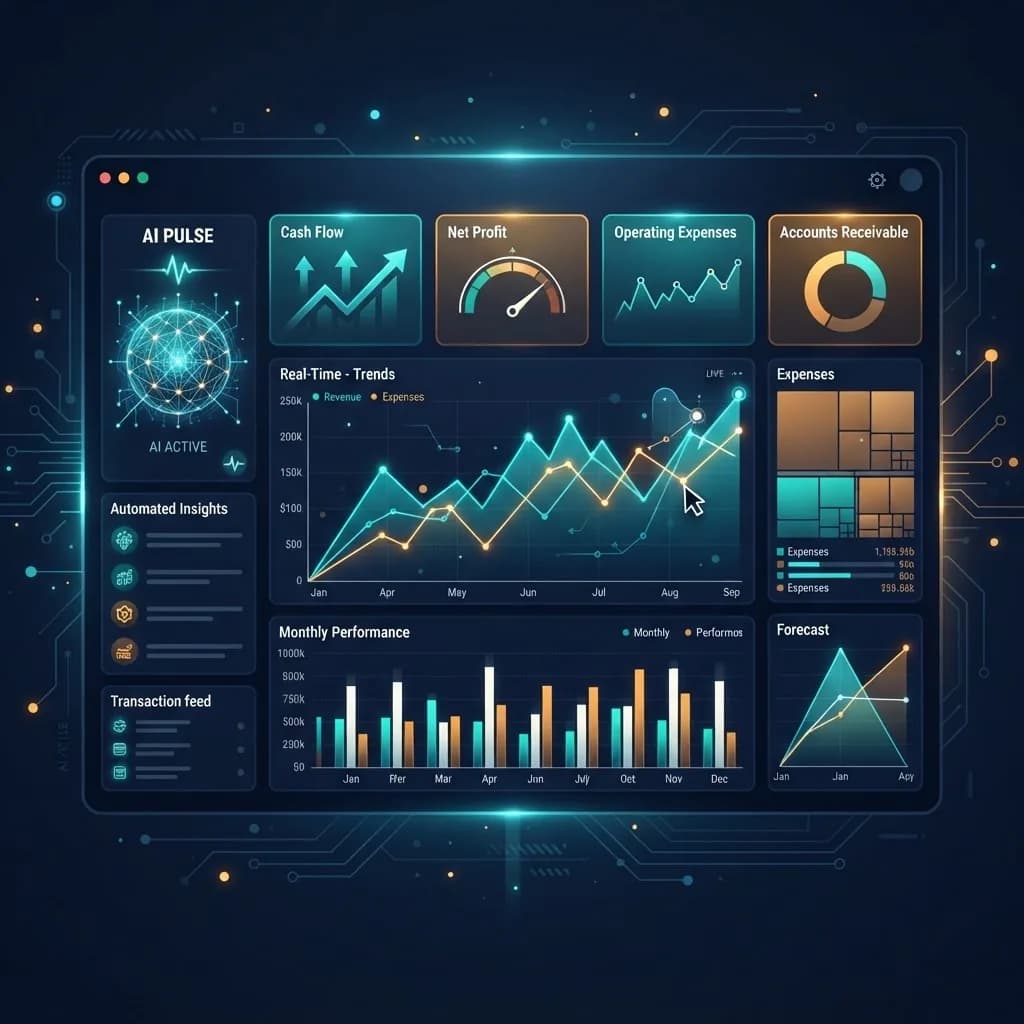
Traditional accounting looks backward. By the time month-end close is finished, the numbers describe a reality that has already passed. Real-time AI accounting insights platforms flip that model. By combining live data feeds with machine learning, they deliver continuous, forward-looking visibility into a company's finances. This guide explains how these platforms work, what to look for, and why they are becoming essential for modern finance teams.
What Are Real-Time AI Accounting Insights Platforms?
These platforms continuously ingest financial data, from bank feeds, invoices, payroll, and spend, and use AI to categorize, analyze, and interpret it as it arrives. Instead of waiting for a monthly report, decision-makers see up-to-date metrics, forecasts, and alerts at any moment. The emphasis is on insight: not just showing numbers, but explaining what they mean and what might happen next.
Why Real-Time Matters
Business moves quickly, and stale financials lead to slow or wrong decisions. Real-time insight changes the game in several ways:
- Faster decisions: leaders act on current data rather than last month's snapshot.
- Early warnings: cash-flow crunches and overspending are caught before they become crises.
- Continuous close: the books stay current, shrinking the month-end scramble.
- Confident planning: forecasts update automatically as reality changes.
Core Features to Look For
The best platforms share a set of capabilities that turn raw data into actionable intelligence.
Live Data Integration
Direct bank feeds and connections to your ledger, payroll, and spend tools are the foundation. Without continuous data, real-time insight is impossible.
Automated Categorization and Reconciliation
AI codes transactions and matches records as they arrive, keeping the underlying data clean enough to trust.
Predictive Analytics
Forecasting engines project cash flow, revenue, and expenses, and update those projections as new data lands.
Anomaly Detection and Alerts
Models flag unusual transactions, budget overruns, or emerging risks and notify the right people immediately.
Natural-Language Insights
Leading tools let you ask questions in plain English, such as why margins dipped last week, and receive clear answers backed by the data.
Dashboards and Visualization
Intuitive, always-current dashboards make the metrics accessible to non-accountants across the business.
The Platform Landscape
Real-time insight capabilities show up in a few types of tools. Cloud ledgers like QuickBooks Online and Xero provide live feeds and increasingly rich reporting. Dedicated FP&A and analytics platforms layer forecasting and scenario modeling on top of accounting data. Spend management tools such as Ramp and Brex offer real-time visibility into card and vendor spending. And a growing wave of AI-native finance platforms is built specifically to deliver continuous, insight-driven reporting. The right mix depends on your size, complexity, and existing stack.
Benefits for Finance Teams
The payoff extends across the organization. Finance teams spend less time assembling reports and more time advising the business. Executives get a live pulse on performance instead of a lagging snapshot. Cash management improves because shortfalls are visible early. And because the data is continuously reconciled, audits and month-end close become far less painful. In short, finance shifts from a reactive scorekeeper to a proactive strategic partner.
Challenges to Anticipate
Real-time platforms are not magic. Their insights are only as good as the data feeding them, so clean, well-connected sources are essential. AI predictions carry uncertainty and should inform rather than dictate decisions. Data security is paramount given the sensitivity of financial information, so strong encryption and access controls are non-negotiable. And teams need to build trust in the automation gradually, keeping human oversight for high-stakes numbers.
How to Adopt Successfully
- Connect all relevant data sources so the platform sees the complete picture.
- Validate early outputs against known figures to build confidence.
- Configure alerts around the metrics that matter most to your business.
- Train the team to interpret insights and act on them, not just watch dashboards.
- Maintain human review for critical decisions and reporting.
From Reporting to Foresight
The real shift these platforms deliver is a move from reporting what happened to anticipating what will happen. A traditional report tells you last month's revenue; a real-time insights platform tells you that, at the current burn rate, cash will dip below a comfortable threshold in eleven weeks, and suggests which levers might change that. This forward orientation transforms finance from a rear-view mirror into a navigation system. Leaders can run scenarios, adjust plans, and course-correct before problems materialize rather than explaining them after the fact.
Predictive analytics is what makes this possible. By learning from historical patterns and continuously incorporating fresh data, these models project cash flow, revenue, and expenses with steadily improving accuracy. They are not crystal balls, and their forecasts carry uncertainty, but they turn planning from a static annual exercise into a living process that updates as reality unfolds.
Real-World Scenarios Where This Matters
- Managing a cash crunch: early warning of a shortfall gives time to arrange financing or cut spend before it becomes a crisis.
- Scaling quickly: a fast-growing company can watch unit economics and burn in real time as it expands.
- Seasonal businesses: continuous forecasting helps plan for predictable peaks and troughs with confidence.
- Board and investor reporting: always-current dashboards make updates faster and more credible.
Integrating With the Broader Finance Stack
A real-time insights platform rarely operates alone. It sits on top of your ledger, bank feeds, spend tools, and payroll, stitching them into a single continuous view. This is why integration quality matters so much: the value of the insights is directly tied to how completely and cleanly the platform can see your data. When integrations are solid, the platform becomes a genuine command center for finance. When they are patchy, the insights are only as reliable as the weakest connection. Prioritize platforms that connect natively to the systems you already use, and invest the time upfront to get those connections clean, because everything downstream depends on it.
Key Takeaways
- Real-time platforms combine live data feeds with AI to deliver continuous, forward-looking financial visibility.
- They shift finance from reporting what happened to anticipating what will happen, enabling faster decisions and earlier warnings.
- Core features include live integration, automated categorization, predictive analytics, anomaly alerts, and natural-language insights.
- Insights are only as good as the data, so clean, complete integrations and human oversight remain essential.
- Adopted well, these platforms turn finance into a proactive strategic partner rather than a backward-looking scorekeeper.
Related Services
If you are building or scaling systems around the ideas in this guide, these professional services can help:
Frequently Asked Questions
How real-time is real-time?
It depends on the data source. Bank feeds typically update at least daily, while internal data like spend or invoices can update instantly. The platform stitches these together into a continuously refreshed view.
Do these platforms replace my accountant?
No. They automate data work and surface insights, but human judgment, interpretation, and accountability remain essential.
Are real-time insights accurate enough to trust?
When fed clean data and reviewed by humans for critical figures, they are highly valuable. Treat AI forecasts as informed guidance rather than certainty.
Conclusion
Real-time AI accounting insights platforms turn finance from a backward-looking function into a live, forward-looking advantage. By combining continuous data feeds with automation, prediction, and clear visualization, they help teams decide faster, catch problems earlier, and plan with confidence. Choose a platform that integrates cleanly with your data, adopt it with human oversight, and your finance function will become a genuine strategic partner to the business.
Enjoyed this article? Share it with others!