
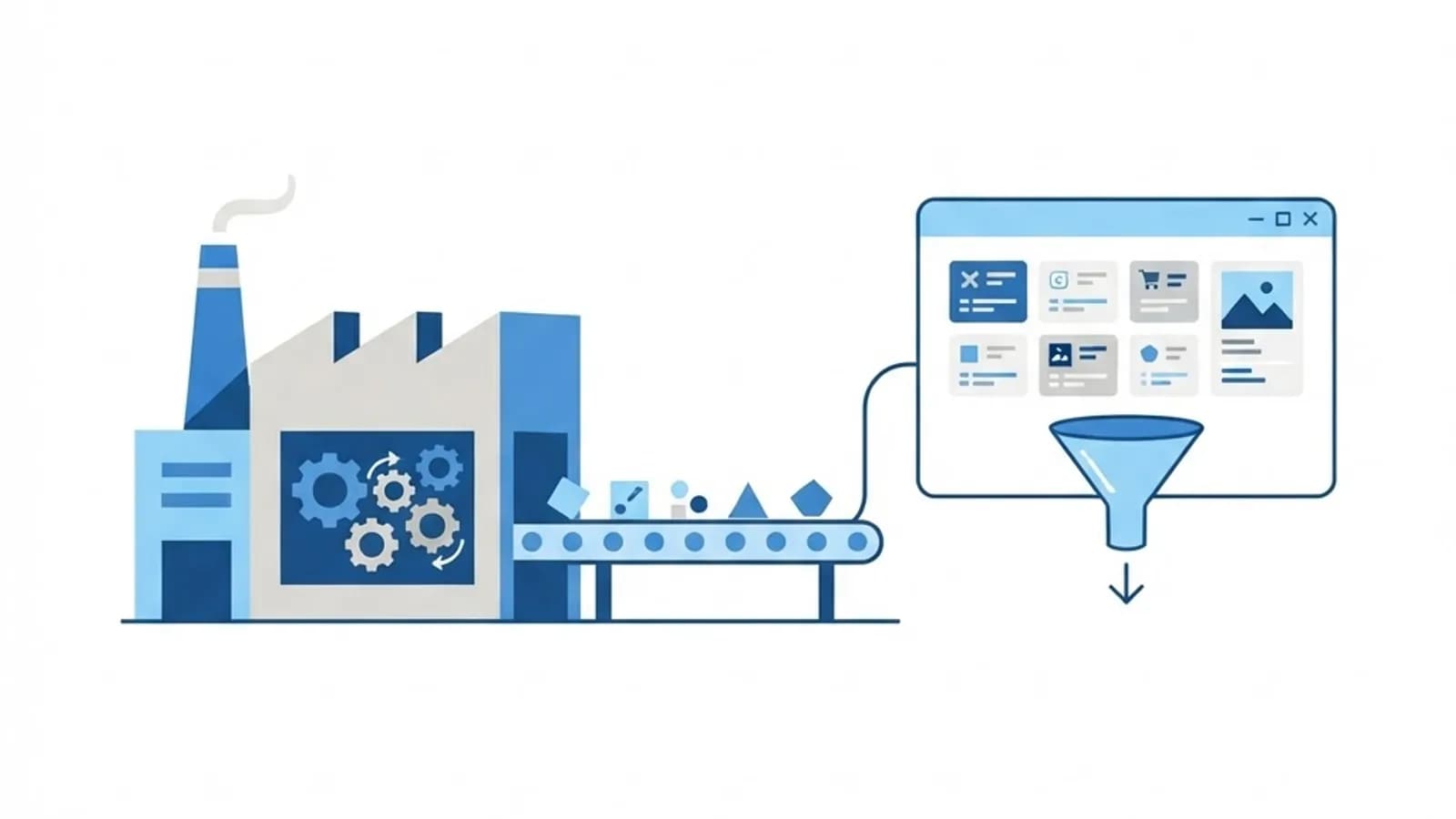
Industrial buyers changed how they buy long before most manufacturers changed how they sell. Manufacturing digital marketing services exist to close that gap, turning a company's engineering credibility into search visibility and qualified requests for quotation.
The modern procurement journey is largely anonymous. Engineers and buyers shortlist suppliers by searching specifications, reading datasheets and checking capabilities, often completing most of their evaluation before contacting anyone.
This article explains which services genuinely move the needle for manufacturers, how to prioritise them with limited resource, and what realistic results look like over the first year.
What Are Manufacturing Digital Marketing Services?
They are the specialist activities that make a manufacturer discoverable and credible online to technical buyers: industrial SEO, specification content, capability documentation, lead capture, distributor enablement and analytics tied to quote value.
The purpose is different from consumer marketing. Success is measured in qualified RFQs and quoted value, not traffic or engagement, because a single new account can be worth years of marketing budget.
That means the work concentrates on a narrow set of high-intent searches and on removing every obstacle between a buyer finding you and submitting a detailed enquiry.
Who Needs Them?
Almost every manufacturer selling into a competitive supply chain benefits, though the urgency varies.
- Contract manufacturers and job shops competing for new programme work
- Component suppliers whose parts are specified by design engineers
- Equipment builders selling capital machinery with long evaluation cycles
- Manufacturers seeking to reduce dependence on a small number of large accounts
- Companies expanding into new industries or export markets
Key Features of Industrial Marketing Services
Specification and Capability Content
Pages covering tolerances, materials, certifications, machine list and typical part sizes attract engineers searching for precisely those parameters. This content is unglamorous and extraordinarily effective because almost nobody publishes it well.
Technical SEO for Complex Catalogues
Large product ranges create indexing, duplication and filtering problems that ordinary SEO advice ignores. Handling faceted navigation and structured data properly often requires serious back-end development work rather than plugin configuration.
Frictionless RFQ Capture
Allow drawing and file uploads, accept partial information, and confirm clearly what happens next. Many manufacturers lose enquiries simply because their form demands details a buyer cannot supply at that stage.
Distributor and Rep Enablement
If you sell through channels, your content is also their selling material. Shared asset libraries, co-branded datasheets and consistent messaging multiply the value of everything you produce.
How to Get Started
Manufacturers usually get the fastest returns by fixing fundamentals before adding new activity.
- Audit which of your capabilities are actually described on your website in searchable language.
- Interview your quoting team about the information buyers most often request before quoting.
- Build or rewrite capability pages covering processes, materials, tolerances and certifications.
- Publish downloadable datasheets and CAD files where appropriate, gated only lightly.
- Simplify your RFQ form and enable file uploads with generous size limits.
- Connect form submissions directly into your CRM with source tracking intact.
- Layer targeted paid search over the highest-value capability terms once pages are live.
Benefits
The returns tend to be lumpy but large, which suits manufacturing economics well.
- A steady flow of inbound RFQs from buyers you would never have reached through sales outreach
- Reduced reliance on a handful of major customers, lowering concentration risk
- Better-qualified enquiries, since buyers self-select against published capabilities
- Shorter quoting cycles because technical questions are answered before contact
- Improved recruitment, as strong technical content attracts skilled staff too
Potential Challenges
Industrial marketing has friction points that catch teams out.
- Engineering staff are reluctant to spend time on content, and their input is essential
- Confidentiality concerns limit how much project detail can be published
- Search volumes are small, so patience and precise targeting matter more than scale
- Attribution is hard when an RFQ arrives months after the original research visit
Best Practices and Tips
Approaches that repeatedly work across industrial sectors.
- Write for the engineer, not the procurement generalist, and let precision signal competence
- Publish certifications prominently, as these are frequently used as shortlist filters
- Record a short shop-floor video showing real equipment, which builds trust instantly
- Track quoted value by lead source so marketing is judged on pipeline, not clicks
Real-World Example
A precision machining company with forty employees depended on three automotive customers for most of its revenue. Their website listed services in two vague sentences and had no capability detail whatsoever.
Over six months they published detailed pages for each machining process, listed every machine with its working envelope, documented their quality certifications and added a file-upload RFQ form built on a properly structured custom web development foundation. Inbound RFQs went from roughly one a month to more than a dozen, including medical and aerospace prospects who had found them by searching for specific tolerance capabilities. Two years later, automotive represented under half of revenue.
Why It Matters
Supply chains are being reorganised continuously, and buyers are actively searching for alternative suppliers. Every month a manufacturer stays invisible is a month of shortlists formed without them.
Manufacturing digital marketing services are not about becoming a marketing-led company. They are about making sure that the capability you already have is findable by the people already looking for it.
Frequently Asked Questions
How long before a manufacturer sees RFQs from SEO?
Typically four to eight months for meaningful organic enquiry flow, because industrial terms are low volume but also low competition. Paid search can generate enquiries within weeks while organic builds.
Should we publish pricing?
Full pricing rarely works for custom manufacturing, but indicative ranges, minimum order quantities or typical project sizes help buyers self-qualify and reduce wasted quoting time.
Is LinkedIn worth the effort for manufacturers?
It works well for reaching procurement and engineering leadership, particularly for capital equipment. Combine organic posting with targeted campaigns, and support it with structured email marketing for longer nurture cycles.
Do we need to show customer names?
Not necessarily. Describing the industry, part type and challenge solved is often enough, and avoids confidentiality issues entirely while still demonstrating relevant experience.
Conclusion
Manufacturing digital marketing services deliver when they translate engineering substance into searchable, credible content and then make it effortless to request a quote. The companies that document their capabilities properly win shortlist places by default.
Start with capability pages and your RFQ process, then build from there. Reliable ongoing site support keeps that machinery running while your team concentrates on production.
Enjoyed this article? Share it with others!