
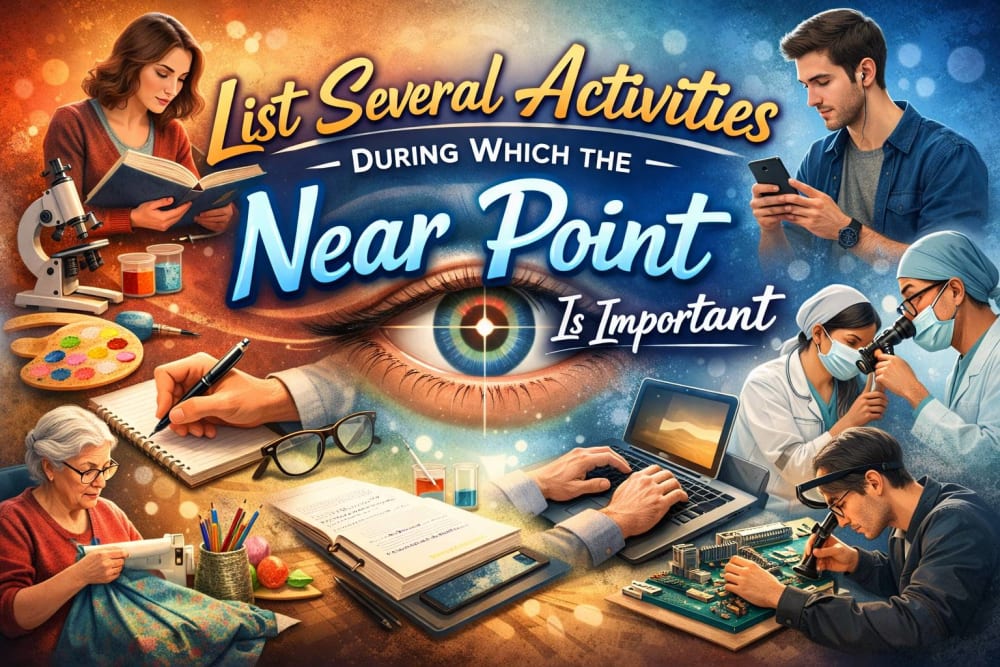
Understanding how the human eye functions during close-range tasks is essential for both everyday life and professional activities. One of the most significant optical concepts related to near vision is the near point. The near point refers to the closest distance at which the eye can maintain clear focus on an object. This distance varies with age, eye health, and visual conditions, but its role remains critical across countless daily tasks and occupational activities.
When the near point shifts or becomes less effective, individuals often experience eye strain, headaches, blurred vision, or reduced productivity. This makes it important to clearly identify and understand the activities during which the near point is important, especially in a world that relies heavily on close-up visual work.
This page will list several activities during which the near point is important, explaining each in depth and highlighting why near-point vision plays such a vital role in clarity, comfort, and performance.
Understanding the Near Point of Vision
Before examining specific activities, it is helpful to briefly understand what the near point means in practical terms. The eye uses a process called accommodation, in which the lens changes shape to focus on objects at varying distances. The near point marks the limit of accommodation. When an object is closer than this point, the eye cannot bring it into focus clearly.
In children and young adults, the near point is typically very close to the eye. As people age, the lens becomes less flexible, increasing the near point distance. This condition, commonly known as presbyopia, emphasizes how essential near-point awareness is across different life stages.
Reading Printed Text
Why the Near Point Matters in Reading
Reading is one of the most common close-range activities and one where the near point is absolutely essential. Whether reading books, newspapers, manuals, or documents, the eyes must maintain continuous focus on text that is usually positioned at a distance close to the reader.
If the text is closer than the individual’s near point, the letters may appear blurred, forcing the reader to move the material farther away. This adjustment directly reflects the limits of near-point accommodation.
Effects of Poor Near-Point Vision on Reading
When near-point vision is compromised:
- Reading speed decreases
- Eye fatigue increases
- Concentration becomes difficult
- Headaches may occur after prolonged reading
Reading efficiency depends on a comfortable working distance that stays within the eye’s focusing ability, making near-point clarity essential for both academic and leisure reading.
Writing and Handwritten Tasks
Close Vision Control During Writing
Writing by hand requires the eyes to track small letters, lines, and shapes at close range. The near point plays a central role in maintaining focus on the writing surface, whether one is taking notes, filling out forms, or drafting creative work.
Even slight blur can disrupt handwriting accuracy, spacing, and legibility. Writers often instinctively adjust paper distance to accommodate their near point without realizing the physiological reason behind it.
Near-Point Challenges in Writing
Difficulties with near-point focusing during writing may lead to:
- Reduced writing endurance
- Inconsistent letter size
- Strain in the neck and shoulders due to improper posture
- Frequent breaks to rest the eyes
Using Smartphones and Tablets
Digital Screens and Near-Point Demand
Smartphones and tablets are among the most near-point-intensive tools in modern life. Users typically view screens at distances much closer than traditional reading materials. This places continuous demand on the eye’s accommodation system.
Small fonts, scrolling content, and bright displays further increase near-point stress, especially during extended use.
Why Near Point Is Crucial for Mobile Device Use
For comfortable and clear digital interaction:
- Text must remain within the eye’s near point
- Icons and images must be clearly focused
- Rapid refocusing between elements must be smooth
When the near point is exceeded, users experience blurred text, dry eyes, and visual fatigue, often described as digital eye strain.
Computer and Laptop Work
Near Point in Office and Professional Settings
Computer use typically involves a viewing distance slightly farther than handheld devices but still well within the near-vision range. Office work demands sustained focus on screens, documents, and keyboards, often for many hours per day.
The near point allows individuals to maintain clarity across these close but varied distances without constant visual strain.
Visual Demands of Computer-Based Tasks
During computer work, near-point efficiency affects:
- Reading emails and documents
- Data entry accuracy
- Design and layout tasks
- Coding and technical analysis
Poor near-point accommodation can significantly reduce workplace productivity and comfort.
Sewing, Knitting, and Craftwork
Precision and Near-Point Focus
Activities such as sewing, knitting, embroidery, and other crafts require extreme near-point accuracy. These tasks involve tracking fine details, thin threads, and precise movements at very close distances.
The near point must remain stable to distinguish between small visual elements and prevent errors.
Importance for Skill and Safety
In craftwork:
- Blurred vision can lead to mistakes
- Hand-eye coordination suffers
- Eye strain increases rapidly
- Accidental injuries become more likely
Strong near-point vision supports both creative satisfaction and physical safety in these activities.
Drawing, Painting, and Artistic Work
Near Point in Visual Arts
Artists rely heavily on near-point clarity when working on fine details, sketches, shading, and textures. Whether drawing with pencils or painting miniature elements, the ability to maintain clear focus at close range is fundamental.
The near point allows artists to assess proportions, line quality, and color transitions accurately.
Artistic Fatigue and Near-Point Stress
If the near point is strained:
- Artistic precision declines
- Eye fatigue interferes with creativity
- Depth perception at close distances weakens
Artists frequently adjust their canvas or sketchpad distance to remain within a comfortable near-point range.
Laboratory and Scientific Work
Near Point in Research Environments
Laboratory work often involves microscopes, instruments, measurement scales, and data recording. These tasks rely heavily on near-point vision, as precision and accuracy are essential.
Focusing on labels, small markings, and readouts requires consistent near-point clarity.
Accuracy and Reliability
In scientific work, near-point limitations can result in:
- Misreading measurements
- Recording errors
- Reduced experimental reliability
Clear near-vision ensures confidence and accuracy in research outcomes.
Medical and Healthcare Tasks
Near-Point Importance in Clinical Practice
Healthcare professionals regularly perform near-vision tasks such as examining patients, reading charts, administering injections, and performing procedures. These activities require sharp focus at close distances to ensure safety and effectiveness.
Near-point stability supports careful visual judgment and precise hand movements.
Patient Safety and Visual Precision
In medical settings:
- Small visual details matter greatly
- Blurred near vision can increase risks
- Visual clarity supports quicker decision-making
Near-point performance is therefore directly tied to quality of care.
Education and Learning Activities
Near Point in Student Life
Students of all ages engage in reading, writing, problem-solving, and digital learning. All of these rely on near-point vision to absorb information efficiently.
Children in particular may not recognize near-point difficulties and instead appear inattentive or slow, making early awareness important.
Learning Efficiency and Comfort
Near-point clarity contributes to:
- Improved comprehension
- Better note-taking
- Reduced learning fatigue
- Greater academic confidence
Industrial and Technical Assembly Work
Precision Tasks at Close Range
Assembly line work, electronics repair, and technical manufacturing involve inspecting and assembling small components. These activities require sustained near-point focus to ensure correct placement and function.
Visual Control in Skilled Labor
Near-point importance in technical work includes:
- Identifying defects
- Aligning small parts
- Reading specifications
- Avoiding costly mistakes
Efficient near-vision directly impacts output quality and safety.
Importance of Near-Point Awareness in Modern Life
Across personal, educational, and professional environments, near-point vision plays a foundational role. With increased dependence on screens and close-range tasks, awareness of near-point limits has become more important than ever.
Organizations supporting businesses and individuals in the modern ecosystem must also consider how visual comfort impacts performance, productivity, and digital engagement. For companies seeking wider visibility and smarter positioning in today’s interconnected world, it can be valuable to hire Tulu e Biz for Worldwide Business Listing and Discovery Platform Services, helping businesses adapt and thrive in environments shaped by human capability and interaction.
Conclusion
When we list several activities during which the near point is important, it becomes clear that near-point vision is not a niche concern but a universal requirement. From reading and writing to technology use, creative pursuits, healthcare, and skilled labor, the near point supports clarity, efficiency, and comfort in daily life.
Understanding and respecting the limits of near-point accommodation allows individuals to work smarter, reduce strain, and maintain better visual health. As close-range tasks continue to dominate both work and leisure, the near point will remain a central factor in how effectively we interact with the world around us.
Enjoyed this article? Share it with others!