
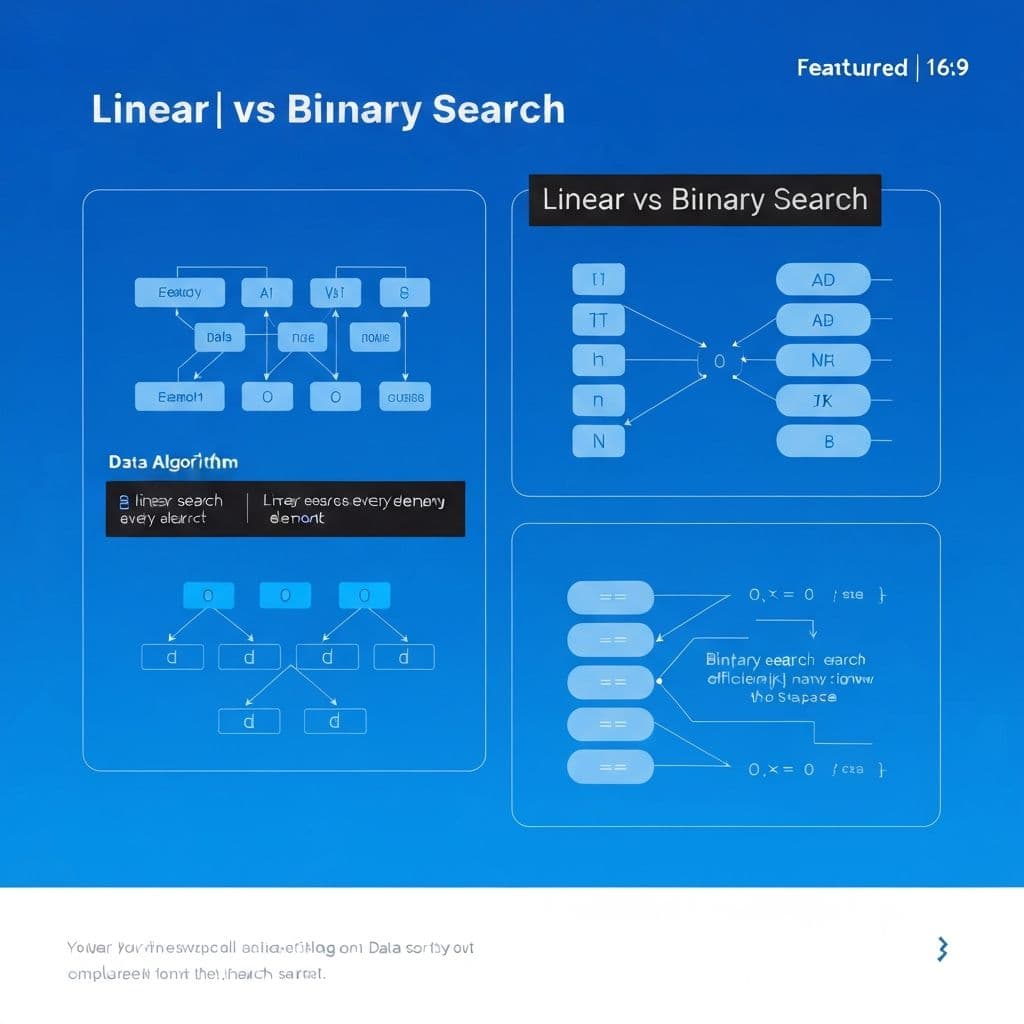
Fundamentals of Search Algorithms
Search algorithms are foundational to computer science, enabling efficient data retrieval from datasets. Linear Search and Binary Search represent two primary approaches with dramatically different characteristics. Linear Search examines elements sequentially, while Binary Search employs divide-and-conquer strategy on sorted data. Understanding differences between these algorithms is crucial for algorithm design, interview preparation, and performance optimization.
Algorithm choice significantly impacts application performance, particularly with large datasets. Choosing inappropriate algorithms results in unnecessary computational overhead and poor user experience. Mastering both algorithms enables informed decision-making when designing systems and solving problems. At Tulu E Biz, we emphasize algorithm efficiency in every project we undertake.
Linear Search Explained
Linear Search, also called Sequential Search, scans elements one-by-one from beginning to end until finding the target or exhausting all elements. The algorithm requires no preconditions—it works on unsorted data. Implementation is straightforward: start at first element, check if it matches target, move to next element, repeat until found or list ends.
Time Complexity for Linear Search is O(n) in worst case—when target is at end or absent—and O(1) in best case when target is first element. Average case remains O(n). Space Complexity is O(1) as the algorithm requires minimal additional memory. Linear Search suits small datasets, unsorted data, or when elements rarely need searching. It's ideal for teaching algorithm fundamentals due to simplicity and understandability.
Binary Search Explained
Binary Search operates on sorted arrays using divide-and-conquer strategy. The algorithm compares target with middle element—if equal, search succeeds. If target is smaller, search left half; if larger, search right half. This process repeats recursively until finding the target or search space exhausts. Binary Search dramatically outperforms Linear Search on large sorted datasets.
Time Complexity for Binary Search is O(log n) for all cases—best, average, and worst. Space Complexity depends on implementation: O(1) for iterative approach, O(log n) for recursive due to call stack. Binary Search requires pre-sorted data, making it unsuitable for unsorted collections. The logarithmic performance makes Binary Search optimal for large datasets where Linear Search would prove prohibitively slow.
Time Complexity Comparison
Understanding time complexity differences is crucial for algorithm selection. With small datasets (100 elements), differences remain negligible—both complete searches rapidly. However, with larger datasets, differences become dramatic. With 1,000 elements, Linear Search requires average 500 comparisons while Binary Search requires maximum 10 comparisons.
With 1,000,000 elements, Linear Search requires average 500,000 comparisons while Binary Search requires maximum 20 comparisons. With 1 billion elements, Linear Search needs average 500 million comparisons versus Binary Search's 30 comparisons maximum. These comparisons demonstrate Binary Search's exponential advantage with growing dataset size. The difference transforms from negligible microseconds with small data to seconds or minutes with massive data.
Preprocessing Requirements
Linear Search works immediately on any data without preprocessing. Unsorted data, partially sorted data, or chaotic structures present no problems—the algorithm adapts to any input. This flexibility makes Linear Search valuable when dealing with dynamic, frequently-modified data where sorting becomes expensive.
Binary Search demands sorted data prerequisite. Sorting requires O(n log n) time with efficient algorithms. For one-time searches on unsorted data, sorting adds overhead exceeding Linear Search benefits. However, when performing multiple searches on static data, sorting once followed by multiple Binary Searches becomes worthwhile. The sorting investment amortizes across multiple searches, eventually saving time compared to repeated Linear Searches. Sorting suitability depends on search frequency and data modification patterns.
Space Complexity Analysis
Space complexity often receives less attention than time complexity but matters significantly in memory-constrained environments. Linear Search requires O(1) additional space—no extra data structures beyond loop variables. Iterative Binary Search similarly requires O(1) additional space. Recursive Binary Search requires O(log n) stack space for recursive calls, becoming significant with very large datasets.
In embedded systems, IoT devices, or memory-limited environments, space complexity considerations become paramount. Linear Search's minimal space requirements make it suitable even when Binary Search's time advantages don't justify recursive stack usage. Iterative Binary Search implementations provide time efficiency without space overhead, representing optimal compromise for space-constrained systems.
Practical Implementation Considerations
Implementing Linear Search is trivial—suitable as introductory programming exercise. Most languages provide built-in functions for both searches, but understanding implementation fundamentals aids troubleshooting and customization. Implementing correct Binary Search proves surprisingly challenging due to off-by-one errors and boundary condition handling.
Common Binary Search errors include incorrect midpoint calculations causing infinite loops, improper boundary updates, or incorrect comparison logic. Test cases must include edge scenarios—single element arrays, missing targets, duplicate values, and extreme values. Thorough testing prevents subtle bugs in production systems. Many programming libraries provide optimized Binary Search implementations (Java's binarySearch, Python's bisect) reducing implementation burden.
When to Use Linear Search
Linear Search remains appropriate for several scenarios. Small datasets (typically under 100-1000 elements) show minimal performance differences regardless of algorithm. Unsorted data without sorting opportunity makes Linear Search only viable option. Linked lists without indexed access make Binary Search infeasible. Searching for first occurrence with specific conditions that require examining all elements anyway favors Linear Search.
Real-time systems with strict latency requirements sometimes prefer Linear Search's predictability over Binary Search's variable performance despite slower average times. Applications rarely search the same dataset repeatedly often choose Linear Search's simplicity over preprocessing overhead. Educational contexts teach Linear Search for foundational understanding. When simplicity trumps performance, Linear Search remains valid choice.
When to Use Binary Search
Binary Search becomes obvious choice for large sorted datasets with multiple searches. Databases, sorted files, and indexed structures typically employ Binary Search. Applications performing frequent searches on stable data benefit from sorting investment amortization. Performance-critical systems handling massive datasets require Binary Search's efficiency.
Real-time systems with latency constraints benefit from Binary Search's O(log n) guarantee over Linear Search's O(n) average. Predictable performance makes Binary Search suitable for systems with strict SLAs. Web search engines, autocomplete systems, and recommendation engines all rely heavily on Binary Search for efficiency. When data is already sorted or sorting is inexpensive relative to search frequency, Binary Search provides clear advantage.
Hybrid Approaches and Optimizations
Sophisticated systems sometimes employ hybrid approaches combining algorithms. Interpolation Search provides O(1) best case on uniformly distributed data while maintaining O(n) worst case. Jump Search offers compromise between Linear and Binary Search. Exponential Search combines binary and linear concepts for unbounded searches. Ternary Search divides search space into thirds rather than halves.
Caching, indexing, and parallel searching further optimize searches. Distributed systems employ hash tables, bloom filters, and other data structures accelerating searches. Understanding fundamental algorithms enables building optimized solutions for specific problems. Modern systems often employ multiple techniques layered for maximum efficiency.
Interview and Practical Problem Solving
Algorithm interviews frequently assess understanding of Linear and Binary Search. Questions often ask about complexity analysis, comparison, implementation, or optimization. Understanding differences demonstrates fundamental computer science knowledge. Many interview problems build on Binary Search—rotated array search, finding element range, finding peak—requiring solid foundational understanding.
Real-world problem solving requires algorithm selection judgment. Premature optimization applying Binary Search to small datasets wastes complexity. Conversely, using Linear Search on massive datasets creates performance issues. Balancing simplicity and efficiency through appropriate algorithm choice represents key engineering skill. Understanding trade-offs enables making informed decisions benefiting overall system design.
Conclusion
Linear Search and Binary Search represent fundamental algorithm paradigms with distinct characteristics, trade-offs, and appropriate use cases. Linear Search's simplicity and flexibility suit small or unsorted data, while Binary Search's efficiency dominates large sorted datasets. Understanding time complexity, space requirements, and practical considerations enables informed algorithm selection. Modern systems rarely employ algorithms in isolation, instead combining techniques for optimal performance. By mastering these fundamental algorithms and understanding their differences, you develop algorithmic thinking essential for software engineering excellence.
Enjoyed this article? Share it with others!