
Every marketing database eventually drowns in job titles. One person is a "Growth Marketer," another is a "Demand Gen Lead," a third is "Head of Digital Experience." They may do nearly identical work, but to your segmentation logic they are three unrelated strings.
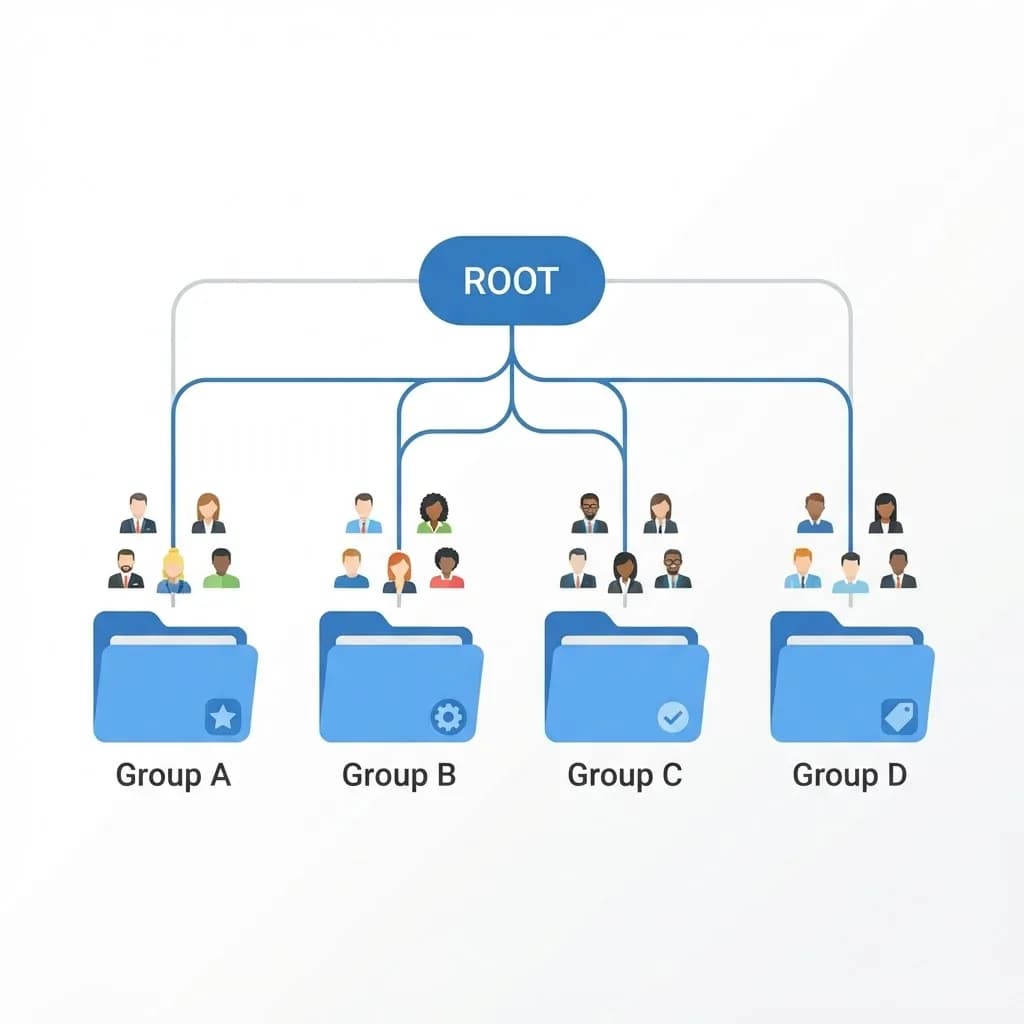
A job title classification taxonomy solves this by mapping thousands of free-text titles onto a controlled set of functions, seniority levels and specializations. For teams working with digital product, experience and marketing data, it is the difference between targeted campaigns and expensive guesswork.
This guide explains how to design one, how to handle the messy edge cases, and how to keep it accurate as job titles keep evolving.
What Is a Job Title Classification Taxonomy?
A job title classification taxonomy is a structured system that maps unstandardized job title strings to standardized categories. It usually operates across several dimensions simultaneously: function, seniority, specialization and sometimes industry context.
For example, "Sr. Performance Marketing Manager, Paid Social" would resolve to function equals Marketing, sub-function equals Performance Marketing, seniority equals Manager, and specialization equals Paid Social. The original string is preserved, but every record becomes queryable along consistent axes.
The value compounds. Once titles are normalized, you can segment campaigns, score leads, analyze which roles convert, and report on audience composition without manual cleanup every time.
Who Needs a Title Taxonomy?
Any organization whose targeting or analytics depends on knowing what people actually do benefits, but some teams cannot function without one.
- B2B marketing teams running account-based campaigns that target specific roles
- Sales operations teams building lead scoring and routing rules
- Product teams analyzing which user roles adopt which features
- Recruiting and talent platforms matching candidates to openings
- Data teams merging records from multiple CRM, enrichment and event sources
Key Features of a Well-Designed Taxonomy
Multi-Dimensional Structure
A single flat list of job categories collapses too much information. Separating function, seniority and specialization into independent dimensions lets you query "all directors in marketing" or "all SEO specialists regardless of level" without maintaining exponentially more categories.
Confidence Scoring
Not every title maps cleanly. "Digital Lead" could mean marketing, product or IT depending on company. Attaching a confidence score to each classification lets downstream systems decide whether to trust it, route it for review, or exclude it from precision-critical campaigns.
Preserved Source Data
Always keep the original raw title alongside the classification. When you refine your rules later, you need to reclassify historical records, and that is impossible if the source string was overwritten. Robust back-end data architecture makes this kind of versioned enrichment straightforward.
Hybrid Rules and Machine Learning
Pure keyword rules break on unusual titles. Pure machine learning is opaque and hard to correct. The most reliable systems use deterministic rules for high-confidence patterns and a classification model for ambiguous cases, with human review on low-confidence output. Teams increasingly build this with applied AI and machine learning services.
How to Build Your Taxonomy
Building one from scratch is a project, but a disciplined sequence prevents the common failure of an over-engineered system nobody maintains.
- Export all distinct job titles from your data sources and count frequency for each.
- Identify the top two hundred titles, which typically cover a majority of your records.
- Define your dimensions, starting with function and seniority before adding specialization.
- Write deterministic mapping rules for the high-frequency titles using normalized text matching.
- Handle abbreviations, punctuation and language variants through a preprocessing normalization layer.
- Train or configure a classifier for the long tail of low-frequency titles.
- Add confidence scoring and route anything below threshold to manual review.
- Schedule quarterly reviews to capture emerging titles and correct systematic errors.
Benefits of Standardized Title Data
The payoff shows up across nearly every function that touches customer data.
- Precise audience targeting that actually reaches decision makers instead of adjacent roles
- More accurate lead scoring because seniority and function are reliable inputs
- Better campaign analysis, since you can compare performance by role segment
- Cleaner data merges when combining records from different platforms
- Reduced wasted ad spend from targeting people without buying authority
Potential Challenges
Title classification is genuinely hard, and anyone promising perfect accuracy is overselling.
- Title inflation means a "Director" at a ten-person startup differs enormously from one at an enterprise
- Multilingual data requires either translation or parallel language-specific rules
- Emerging roles appear constantly, so any static taxonomy decays within a year
- Ambiguous titles like "Consultant" or "Specialist" carry almost no functional information alone
Best Practices and Tips
A few decisions early on determine whether the system stays useful or becomes technical debt.
- Use company size as a modifier for seniority interpretation rather than a separate dimension
- Start with fewer categories than you think you need and expand only when a gap causes real problems
- Log every classification decision so you can audit and improve rules over time
- Build the pipeline as a reusable service rather than a one-off script, ideally through solid custom web application development that other systems can call
Real-World Example
A B2B digital experience platform had ninety-four thousand contacts in their CRM with over eleven thousand distinct job title strings. Campaign targeting relied on keyword contains-matching, which meant "Product Marketing Manager" got included in product-team campaigns and marketing campaigns simultaneously.
They built a taxonomy with four functions relevant to their buyer set, five seniority tiers and twelve specializations. Deterministic rules handled the top four hundred titles covering seventy-one percent of records. A classifier processed the remainder with confidence scoring, and anything below 0.7 went to a weekly review queue.
Post-implementation, email engagement on role-targeted campaigns rose forty-seven percent because messaging finally matched the recipient's actual responsibilities. Sales also stopped receiving leads routed to the wrong specialist team.
Why It Matters
Personalization claims fall apart when the underlying data cannot distinguish a CMO from a marketing coordinator. Every downstream system — scoring, routing, targeting, reporting — inherits the quality of your title data.
A job title classification taxonomy is unglamorous infrastructure, but it quietly determines whether your segmentation is real or theatrical. Teams that invest here find that many of their other data problems were actually title normalization problems.
Frequently Asked Questions
Should I build a taxonomy or buy an enrichment service?
Third-party enrichment providers offer decent general-purpose classification and are faster to implement. Build your own when your buyer personas are unusually specific or when the vendor categories do not align with how you actually segment.
How many categories should a taxonomy have?
Most B2B teams operate well with eight to fifteen functions, four to six seniority tiers, and specializations only within functions that matter to them. Excessive granularity increases maintenance cost without improving targeting.
How do you handle titles in multiple languages?
Either normalize through translation before classification, or maintain language-specific rule sets for your major markets. Translation is simpler but introduces errors on idiomatic titles. Test both against a labeled sample.
How often should the taxonomy be updated?
Review quarterly at minimum. Monitor the volume of unclassified or low-confidence titles as your signal. A rising unclassified rate means new title patterns are emerging faster than your rules cover them.
Conclusion
A job title classification taxonomy turns unusable free-text data into a segmentation asset. Start with your highest-frequency titles, define clear dimensions, add confidence scoring, and commit to ongoing maintenance rather than treating it as a one-time project.
The teams that get this right unlock precision in every downstream system. If you need help designing the data pipeline and classification layer, explore AI-driven data classification solutions built for marketing and product data at scale.
Enjoyed this article? Share it with others!