
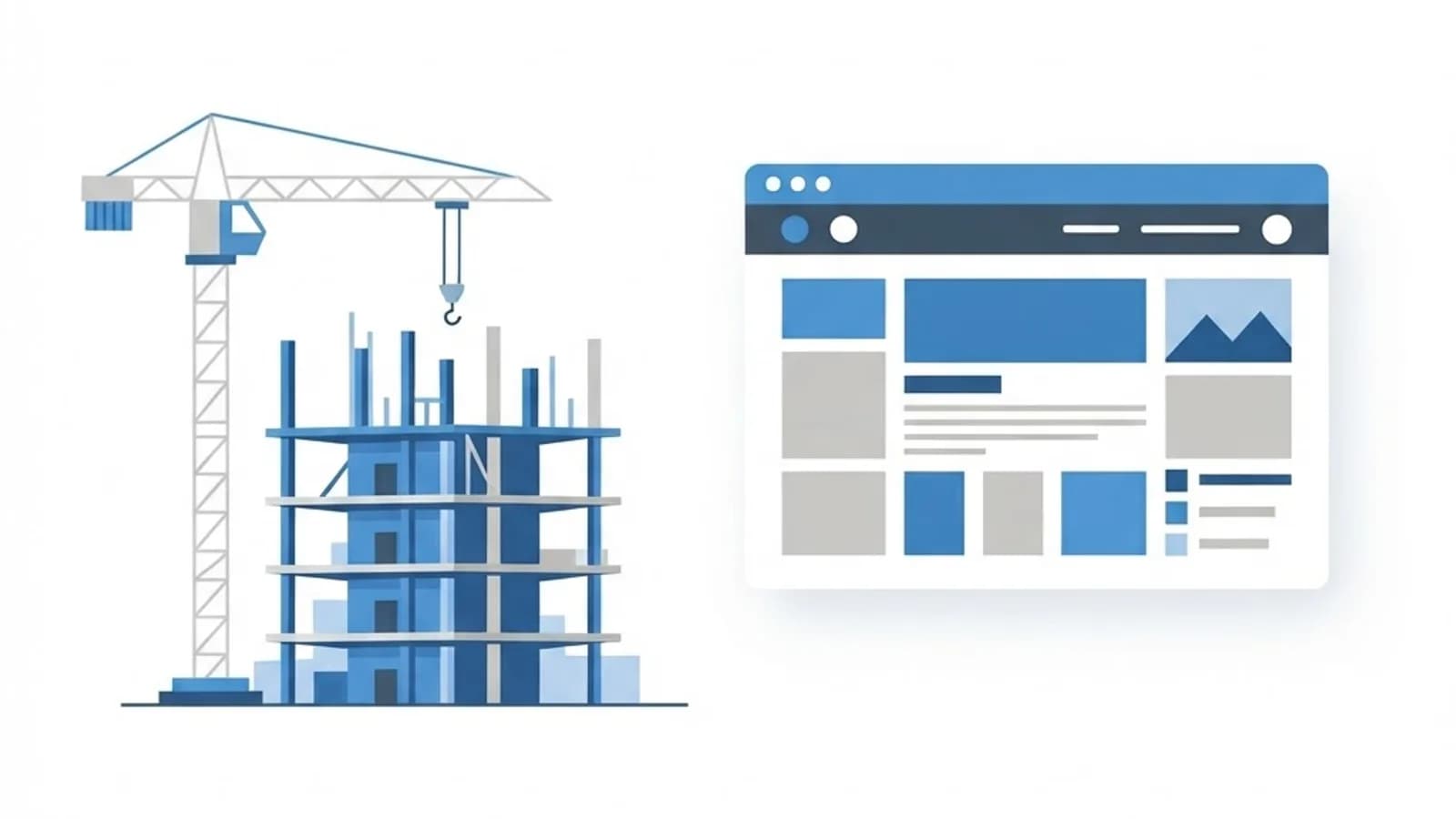
Construction has been slower than most industries to take marketing seriously, largely because relationships and repeat clients carried the workload for decades. That is changing. Procurement teams now shortlist online, project owners research firms before an introduction, and skilled workers judge employers by their web presence. Digital marketing for construction has quietly become a competitive requirement.
It also looks different from consumer marketing. Sales cycles run months or years, decisions involve committees, and a single project win can be worth more than an entire year of small transactions.
This guide covers how construction firms should approach it, which channels justify the effort, and how to measure success when a lead might not close for eighteen months.
What Is Digital Marketing in Construction?
It is the use of online channels to build credibility with project owners, developers, general contractors, and prospective employees. Rather than chasing volume, the goal is authority and discoverability among a relatively small pool of high-value decision makers.
Proof of work is the core asset. Photographs of completed projects, technical case studies, safety records, certifications, and named client references do more persuading than any advertising message. Everything else is a distribution mechanism for that proof.
Who Uses It?
Firms across the sector benefit, though their objectives differ.
- General contractors bidding on commercial and public projects
- Specialty trade subcontractors seeking steady work from GCs
- Design-build firms selling an integrated service
- Civil and infrastructure companies pursuing public tenders
- Residential builders and developers marketing directly to buyers
Key Components
A Project Portfolio That Functions as Evidence
Each completed project deserves its own page with scope, challenges, timeline, value delivered, and strong photography. This is the single highest-return asset a construction website can have, and it serves sales, recruitment, and search visibility at once.
Technical Content and Thought Leadership
Articles about methods, compliance, materials, and sequencing attract exactly the audience you want. They also give business development teams something credible to share during long sales cycles.
Recruitment Marketing
Labour shortage is the industry's defining constraint. A careers section that shows real crews, real sites, and real progression paths competes for talent as directly as it competes for projects.
A Site Built for Heavy Visual Content
Project galleries and drone footage are large files. Without careful engineering the site crawls. Firms often solve this with a structured content platform such as Strapi CMS website development so project pages can be published quickly without a developer each time.
How to Get Started
A construction marketing programme is best built in a deliberate sequence.
- Photograph and document your last ten completed projects properly.
- Publish each as a standalone case study with measurable outcomes.
- Rebuild service pages around the sectors you want more of, not everything you can do.
- Add certifications, safety statistics, and insurance details prominently.
- Create a careers section with genuine day-in-the-life content.
- Set up a CRM so long sales cycles are tracked rather than forgotten.
- Use targeted advertising on professional networks to reach procurement roles.
Benefits
The returns show up in both pipeline and payroll.
- Shortlisting by clients who found you before you ever met
- Stronger negotiating position because credibility is established in advance
- Reduced recruitment costs through inbound applications
- Less dependence on a handful of repeat clients
- A searchable archive of expertise that supports every bid
Potential Challenges
There are genuine obstacles, and pretending otherwise helps nobody.
- Client confidentiality restricting what you can publish
- Very long attribution windows that make monthly reporting meaningless
- Field teams too busy to capture site photography consistently
- Internal scepticism about marketing spend during a busy period
Best Practices and Tips
Practical habits that make the programme sustainable.
- Give site managers a simple photo checklist and a shared upload folder
- Ask for a testimonial at project handover while goodwill is highest
- Focus on two or three sectors rather than presenting as a generalist
- Track pipeline influence, not just lead count, given the sales cycle
- Use clear infographic design to explain complex processes to non-technical clients
Real-World Example
A mid-sized commercial contractor relied on three developer relationships for most of its revenue. When one of those developers was acquired, a third of the pipeline vanished within a quarter.
The response was to build visibility deliberately. They documented eleven completed projects in detail, published quarterly technical pieces on tenant fit-out sequencing, and targeted advertising at facilities and development managers in their region. The first inbound enquiry took four months. Within two years, inbound accounted for roughly a quarter of new bids and, more importantly, the firm was being invited to tenders it previously had no route into.
Why It Matters
Construction is a trust business, and trust now forms online before the first meeting. A procurement lead will look at your website, your project history, and your safety record before deciding whether to include you on a shortlist.
If that research turns up a thin site with a 2016 copyright date, the relationship never starts. The firms investing now are buying a position that is difficult for competitors to reverse quickly.
Frequently Asked Questions
Does SEO work for commercial construction?
Yes, but the valuable terms are specific: sector plus service plus region. Volume is low and intent is extremely high, so a handful of rankings can be worth a great deal.
How do we market projects under confidentiality?
Anonymise the client, describe the scope and challenge generically, and focus on the technical approach. Many firms publish case studies without naming anyone and still demonstrate capability clearly.
Is social media relevant for contractors?
Professional networks are valuable for recruitment and business development. Visual platforms work well for residential builders. General consumer social rarely justifies effort for commercial firms.
How should we measure return on a long sales cycle?
Track leading indicators such as qualified enquiries, bid invitations, and pipeline value influenced, then review closed revenue annually rather than monthly.
Conclusion
Digital marketing for construction rewards patience and evidence. Document your work rigorously, publish genuine expertise, and make it easy for both clients and crews to see what you are capable of.
The firms that treat their project archive as a marketing asset consistently outperform those that treat it as paperwork. If your current site cannot handle that volume of content, a purpose-built web application will pay for itself in bids won.
Enjoyed this article? Share it with others!