
When companies hire a senior growth marketer, one question causes more internal debate than compensation: what department for demand generation and digital marketing leader roles actually makes sense? Marketing seems obvious, until sales asks for the pipeline number and revenue operations claims the reporting stack.
The answer shapes real outcomes. Department placement decides who sets the target, who approves the budget, which systems the team controls, and how quickly decisions get made.
This guide walks through the common structures, the trade-offs of each, and how to choose the one that fits your stage and go-to-market model.
What Is the Department for a Demand Generation and Digital Marketing Leader?
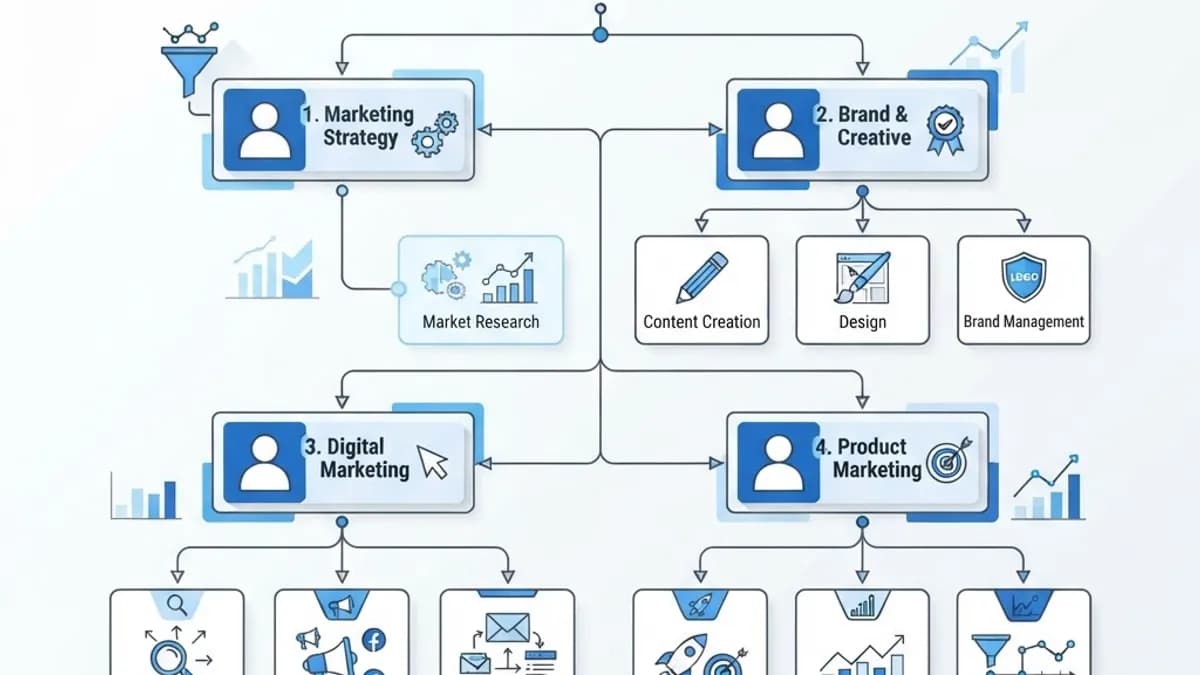
In the large majority of companies, the department for demand generation and digital marketing leader roles is Marketing, typically inside a Growth Marketing or Demand Generation sub-function reporting to a CMO or VP of Marketing. The leader sits alongside product marketing, brand, and communications.
The exception is revenue-led organizations, where demand generation reports into a Chief Revenue Officer or a unified Revenue department that also owns sales and sales development. This is increasingly common in B2B SaaS, where pipeline accountability is shared rather than handed off.
A third pattern places the role in Growth as its own department, separate from brand marketing. This shows up in product-led companies where acquisition, onboarding, and monetization experiments matter more than campaign calendars.
Who Uses Each Department Structure?
Structure follows business model. The right home for the role depends on how your company actually generates revenue and how mature your teams are.
- Traditional B2B and enterprise companies place the role under Marketing with a dotted line to Sales, keeping brand and demand under one CMO.
- Revenue-led SaaS organizations put it under a CRO so pipeline targets, sales development, and paid acquisition share one owner.
- Product-led and self-serve businesses build a standalone Growth department blending marketing, data, and product engineering.
- Startups under fifty people usually have no separate department at all; the leader reports directly to the CEO or founder.
- Ecommerce and DTC brands often place the role inside a Performance Marketing or Ecommerce department tied closely to merchandising and ecommerce platform operations.
Key Features of a Well-Structured Department
Clear Pipeline Accountability
Whatever department owns the role must own a number that connects to revenue. If demand generation sits in Marketing but sales sets the pipeline target unilaterally, you get finger-pointing at every quarterly review. The strongest structures define a shared pipeline goal with jointly agreed conversion assumptions between marketing and sales leadership.
Direct Budget Authority
The department needs its own media and technology budget with the leader empowered to reallocate between channels mid-quarter. Demand generation without spend flexibility cannot respond to performance data, which is the entire point of the function.
Ownership of the Digital Stack
The department should control or co-own the marketing automation platform, the website, analytics, and the ad accounts. When website changes require a six-week engineering queue, conversion optimization stops happening. Many teams solve this by pairing with a dedicated partner for front-end web development so landing pages ship on marketing timelines.
Defined Interfaces With Adjacent Teams
A good structure documents handoffs: how leads pass to sales development, how product marketing supplies messaging, and how RevOps maintains data hygiene. Ambiguous interfaces, not bad people, cause most demand generation failures.
How to Set Up the Department
Designing the department is a sequence of decisions rather than an org chart drawn in one sitting. Work through it in this order.
- Define the revenue motion first. Sales-led, product-led, or hybrid. Structure should follow how buyers actually buy from you.
- Choose the reporting line. CMO for brand-integrated companies, CRO for pipeline-driven ones, CEO for early-stage teams that need speed.
- Write the accountable metric. One primary number, such as qualified pipeline or new revenue sourced, plus two or three supporting metrics.
- Set budget authority in writing. Total annual spend, approval thresholds, and how much can move between channels without escalation.
- Assign system ownership. Name the owner of the CRM, marketing automation, website, and analytics before the first campaign launches.
- Hire in dependency order. Paid acquisition and lifecycle first, then content and marketing operations, then analytics as volume grows.
- Institute a shared review cadence. A weekly pipeline meeting with sales leadership keeps the structure honest.
Benefits of Getting Department Placement Right
Organizational design sounds abstract until you see how much friction the wrong structure creates. The right placement pays off quickly.
- Decisions get made faster because budget and accountability live in the same place.
- Marketing and sales argue about strategy instead of arguing about whose fault the miss was.
- The leader can attract stronger talent because the role has genuine scope.
- Reporting becomes credible when one department owns the full funnel data model.
- Spend efficiency improves as channel reallocation happens in days rather than quarters.
Potential Challenges
No structure is free of tension. Anticipating the predictable failure modes is more useful than searching for a perfect chart.
- Turf conflict with sales development. Both marketing and sales often want to own the SDR team, and the answer genuinely depends on your motion.
- Brand versus performance tension. When both live under one CMO, short-term pipeline pressure tends to starve long-term brand investment.
- Data ownership disputes. Without a clear RevOps agreement, attribution arguments consume leadership attention.
- Structure outgrowing itself. A setup that works at thirty people usually breaks at a hundred and fifty and needs a deliberate redesign.
Best Practices and Tips
A few disciplines keep the department effective as the company grows and priorities shift.
- Document the charter. A one-page description of scope, metrics, budget, and interfaces prevents most future disputes.
- Revisit structure annually. Treat the org chart as a living decision tied to strategy, not a permanent fixture.
- Keep creative capacity close. Fast access to design resources, whether internal or through a professional graphic design team, is what makes rapid testing possible.
- Protect experimentation budget. Ring-fence ten to fifteen percent of spend for new channels so the department does not calcify around what already works.
Real-World Example
A mid-market B2B software company had its demand generation leader reporting to the VP of Marketing, while the sales development team reported to the VP of Sales. Marketing was measured on MQLs and hit target every quarter. Sales complained the leads were unusable, and pipeline stayed flat for three quarters.
The fix was structural, not tactical. Leadership moved demand generation and sales development under a single Revenue department led by a CRO, replaced the MQL target with a qualified pipeline target, and gave the demand generation leader shared ownership of the lead scoring model. Within two quarters, lead volume dropped by roughly a third while qualified pipeline rose meaningfully, because the department was finally optimizing for the outcome it was measured on.
Why It Matters
Department placement is the quiet variable behind most marketing performance stories. Two companies can hire identically talented leaders and get opposite results purely because one gave the role budget, systems, and a revenue metric while the other gave it a title and a lead quota.
Choosing the right department for demand generation and digital marketing leader roles is therefore a strategic decision, not an HR formality. It determines whether your best growth hire can actually do the job you hired them for.
Frequently Asked Questions
Does demand generation belong in marketing or sales?
Most often marketing, but revenue-led B2B companies increasingly place it under a Chief Revenue Officer alongside sales development. The deciding factor is whether pipeline accountability is shared or handed off between teams.
Who should a demand generation leader report to?
A CMO or VP of Marketing in brand-integrated companies, a CRO in pipeline-driven organizations, and the CEO directly at early-stage startups where speed matters most.
Is demand generation the same as growth marketing?
They overlap heavily. Demand generation traditionally focuses on sales pipeline in B2B, while growth marketing spans the whole lifecycle including onboarding and retention, often in product-led businesses.
What roles sit inside the department?
A typical team includes paid acquisition, lifecycle or email marketing, marketing operations, content, and analytics, with SEO and web either inside the department or shared with a central web team.
Conclusion
Deciding the right department for demand generation and digital marketing leader roles comes down to matching structure to revenue motion, then giving the department a real number, a real budget, and control of its digital stack. Marketing, Revenue, and Growth are all valid homes when those three conditions are met.
If your structure is sound but execution is bottlenecked by slow websites or thin creative capacity, that is a solvable problem. Take a look at expert web development services to give your demand generation department the speed it needs.
Enjoyed this article? Share it with others!