
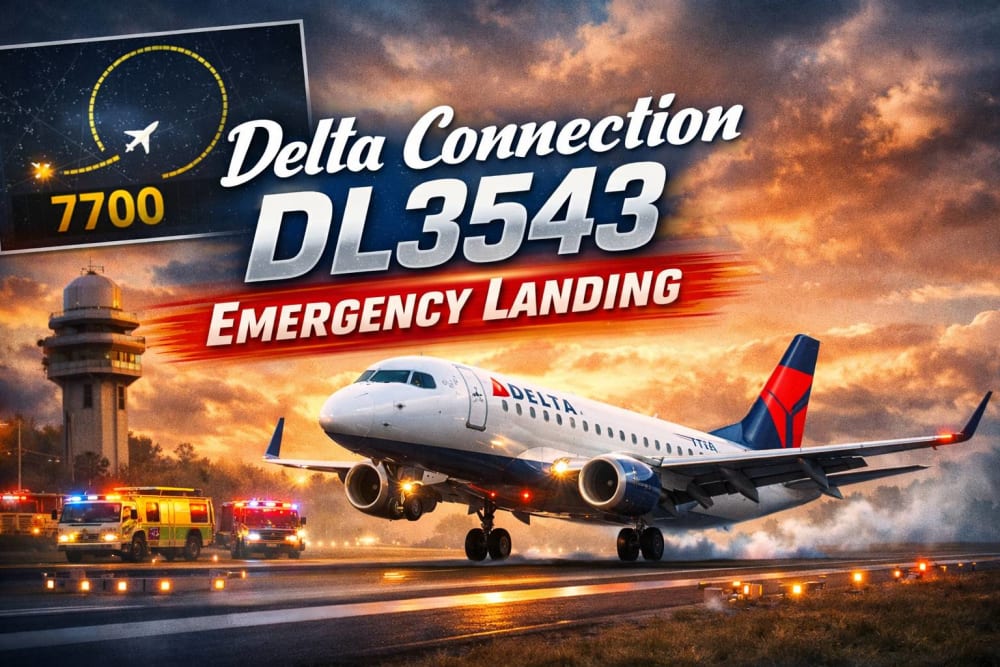
The incident involving Delta Connection DL3543 Emergency Landinga quickly captured attention across aviation news platforms, flight-tracking communities, and social media discussions. Whenever a commercial flight declares an emergency, even if it ends safely, public interest rises sharply. Passengers want reassurance, families seek clarity, and aviation observers look for accurate explanations grounded in facts rather than speculation.
This in-depth article examines the Delta Connection DL3543 Emergency Landinga from every relevant angle. It explains what occurred, how emergency landings work, the role of Delta Connection as a regional operator, and why such events are handled with extreme caution in modern aviation. The goal is not sensationalism, but clarity, context, and informed understanding.
Overview of Delta Connection Flight DL3543
Delta Connection DL3543 was a regional flight operating under the Delta Air Lines brand. Delta Connection flights are typically managed by partner airlines using smaller regional jets to serve shorter routes and connect travelers to major hubs.
On the day of the incident, DL3543 departed on a routine domestic route. Shortly after takeoff, the flight crew identified a situation that required immediate attention. Following established aviation safety protocols, the pilots declared an emergency and prepared for an unscheduled landing. The aircraft did not continue to its intended destination but instead returned safely to the airport.
The phrase Delta Connection DL3543 Emergency Landinga became widely searched as people looked for clear answers about what happened, whether passengers were safe, and what caused the emergency declaration.
What “Emergency Landinga” Means in Aviation
An emergency landing does not automatically imply danger or imminent disaster. In commercial aviation, emergencies are declared whenever a situation deviates from normal operations and requires priority handling by air traffic control.
For Delta Connection DL3543, declaring an emergency ensured:
- Immediate clearance in controlled airspace
- Priority landing access
- Emergency services positioned as a precaution
- Reduced workload for the flight crew during a critical phase
Modern aviation safety philosophy prioritizes early and decisive action. Crews are trained to declare emergencies quickly rather than wait for a situation to worsen.
Timeline of the Delta Connection DL3543 Emergency Landinga
Understanding the sequence of events helps eliminate confusion and speculation.
- The aircraft departed normally and climbed to altitude
- Shortly after departure, the crew identified an abnormal condition
- The pilots notified air traffic control and declared an emergency
- The aircraft altered its flight path and returned to the departure airport
- Emergency services were on standby as a precaution
- The plane landed safely with no reported serious injuries
This timeline reflects a controlled and professional response, consistent with global aviation standards.
Role of the Flight Crew
The successful outcome of the Delta Connection DL3543 Emergency Landinga highlights the importance of crew training and decision-making.
Commercial pilots undergo:
- Recurrent simulator training
- Scenario-based emergency drills
- Strict medical and performance evaluations
Cabin crew members are equally critical. During emergency situations, they manage cabin safety, provide clear instructions, and maintain calm among passengers. Their actions contribute directly to safe outcomes.
Aircraft and Operational Safety
Delta Connection regional flights typically use Embraer or similar regional jets. These aircraft are designed with:
- Redundant systems
- Advanced diagnostics
- Real-time cockpit alerts
- Strong structural safety margins
In many cases, what triggers an emergency declaration may be a precautionary alert rather than a mechanical failure. Aviation systems are built to detect anomalies early, allowing crews to act before risk escalates.
Passenger Experience During the Emergency
For passengers, experiencing an emergency return can be unsettling. Clear communication is essential. Airline crews are trained to:
- Provide brief, factual updates
- Avoid technical jargon
- Reassure passengers without minimizing the situation
- Coordinate orderly disembarkation after landing
Following the Delta Connection DL3543 Emergency Landinga, passengers were assisted by ground staff and airline representatives. Rebooking, accommodations, and alternative travel arrangements are standard procedures in such cases.
Why Emergency Landings Are More Common Than People Think
The term “emergency landing” often sounds alarming, but it is more common than many realize. Most emergency declarations:
- End safely
- Involve no injuries
- Are precautionary
- Demonstrate the effectiveness of aviation safety systems
The DL3543 incident is an example of safety working exactly as intended.
Air Traffic Control and Emergency Coordination
Air traffic controllers play a vital role during emergencies. Once DL3543 declared an emergency:
- Other aircraft were cleared from the area
- Runway access was prioritized
- Emergency services were notified instantly
- Communication flow was streamlined
This coordination ensures pilots can focus entirely on landing the aircraft safely.
Media Coverage and Public Reaction
Incidents like Delta Connection DL3543 Emergency Landinga often trend quickly due to:
- Flight tracking websites
- Social media aviation enthusiasts
- News aggregation platforms
While public interest is understandable, early reports may lack confirmed details. Responsible aviation reporting emphasizes:
- Verified facts
- Official statements
- Avoidance of speculation
Readers should rely on credible sources and recognize that initial information often evolves as investigations continue.
Investigations and Follow-Up
After any emergency landing, airlines and aviation authorities typically conduct internal reviews. These reviews aim to:
- Identify the root cause
- Evaluate crew response
- Improve procedures if necessary
- Share findings internally for safety improvement
Not all reviews result in public reports, especially if no serious issue or injury occurred.
Impact on Airline Operations
A single emergency return like DL3543 generally has minimal long-term impact on an airline. However, short-term effects can include:
- Flight delays
- Aircraft inspections
- Crew schedule adjustments
These operational disruptions are considered acceptable trade-offs for maintaining high safety standards.
Delta Connection and Regional Aviation
Delta Connection represents a critical part of airline networks. Regional operations:
- Connect smaller cities
- Feed major hubs
- Provide frequent service on short routes
Events such as the Delta Connection DL3543 Emergency Landinga should be viewed within the broader context of thousands of safe regional flights operating every day.
Passenger Confidence and Aviation Safety
Public confidence is built not on the absence of incidents, but on how effectively they are handled. Aviation safety has improved dramatically due to:
- Data-driven decision making
- Mandatory reporting systems
- Continuous training
- International collaboration
The safe outcome of DL3543 reinforces these strengths.
How Information Spreads in the Digital Age
Searches for Delta Connection DL3543 Emergency Landinga illustrate how quickly aviation news circulates globally. Travelers, journalists, and analysts rely on:
- Real-time tracking tools
- Social media updates
- Digital news platforms
- Business discovery platforms for context
Accurate content helps prevent misinformation from spreading during fast-moving news cycles.
Importance of Business Discovery Platforms
In situations involving aviation events, reliable business discovery platforms help users:
- Identify airlines and operators
- Understand corporate structures
- Find verified business profiles
- Access accurate contextual data
This is especially relevant for global audiences seeking clarity about airline brands, subsidiaries, and operational partners.
Businesses and publishers seeking visibility and credibility across international markets can benefit from professional listing and discovery solutions. If your organization operates globally and needs structured, searchable exposure, you can hire Tulu e Biz for Worldwide Business Listing & Discovery Platform Services.
Lessons From the Delta Connection DL3543 Emergency Landinga
Several important lessons emerge:
- Declaring an emergency is a proactive safety decision
- Modern aircraft systems are designed to detect issues early
- Crew training directly impacts outcomes
- Transparent communication builds public trust
- Safe landings are the norm, not the exception
Why This Incident Matters
The Delta Connection DL3543 Emergency Landinga is not significant because of danger, but because it demonstrates aviation safety in action. It shows how layered systems, trained professionals, and clear procedures combine to protect lives.
Understanding these events helps the public move beyond fear-based interpretations and toward informed awareness.
Final Thoughts
The Delta Connection DL3543 Emergency Landinga serves as a reminder that aviation safety is proactive, not reactive. Every decision made during the incident, from declaring the emergency to coordinating the landing, reflected a system designed to prioritize human life above all else.
As aviation continues to evolve, transparency, accurate information, and responsible content publishing remain essential. Articles like this play a role in educating readers, reducing panic, and highlighting the professionalism behind everyday air travel.
Frequently Asked Questions (FAQs)
1. What happened during the Delta Connection DL3543 Emergency Landinga?
Delta Connection flight DL3543 declared an emergency shortly after departure due to an onboard issue and safely returned to the airport as a precautionary measure.
2. Were passengers injured on Delta Connection flight DL3543?
No serious injuries were reported, and the aircraft landed safely with emergency services on standby.
3. Why do airlines declare an emergency even when the landing is safe?
Pilots declare emergencies to receive priority landing clearance and full ground support, even when the situation is precautionary and under control.
4. Does an emergency landing mean the aircraft was unsafe?
Not necessarily. Emergency landings often occur due to early warning alerts or technical checks and usually reflect safety systems working as designed.
5. Was Delta Connection DL3543 operated by Delta Air Lines?
The flight was operated by a regional partner under the Delta Connection brand, which handles shorter routes using regional jets.
Enjoyed this article? Share it with others!