
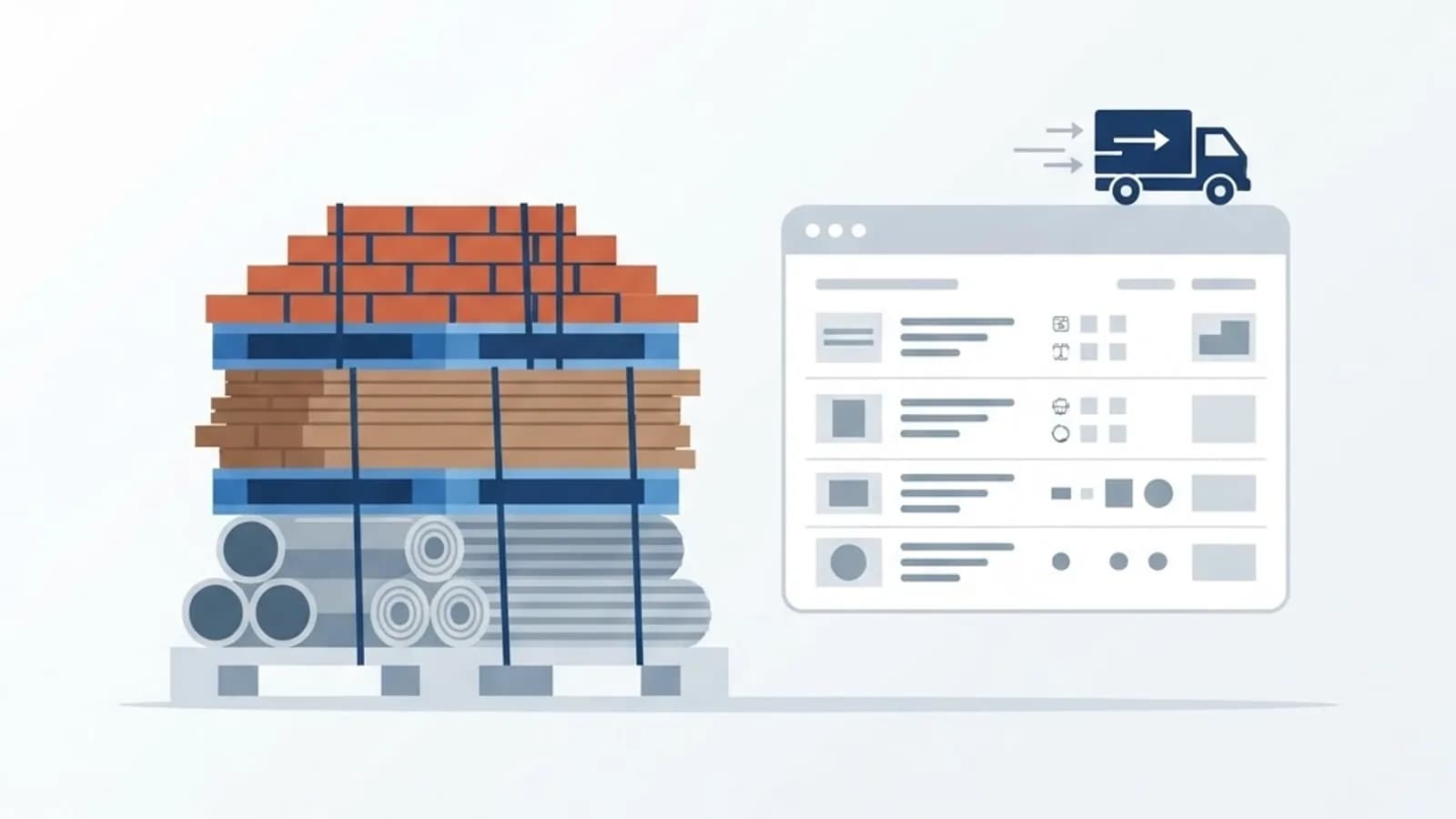
Selling building materials means selling to several audiences at once: the specifier who writes you into a drawing, the contractor who buys on price and availability, and the distributor who decides whether to stock you. Building materials digital marketing has to serve all three without confusing any of them.
Most manufacturers in this sector still market as though the trade counter is the only channel. Meanwhile architects search for product data online, contractors compare options from a phone on site, and distributors evaluate suppliers by how easy they make it to sell.
This guide covers how to build a digital presence that supports specification, purchase and distribution simultaneously.
What Is Building Materials Digital Marketing?
It is the coordinated use of technical content, search visibility, digital product data and channel support to drive specification and purchase of construction products.
The sector's defining characteristic is the split between who chooses a product and who buys it. Specification often happens months before purchase, and the two audiences need entirely different content. Architects want performance data and detailing; contractors want availability, handling and price.
Successful manufacturers build separate content paths for each while maintaining one consistent product data source underneath.
Who Uses It?
Multiple businesses across the construction supply chain benefit from a structured approach.
- Manufacturers of structural, cladding, insulation, roofing and finishing products
- Distributors and builders merchants competing on range and service
- Importers introducing products to a new regional market
- Specialist suppliers of sustainable or high-performance materials
- Fabricators and processors selling to both trade and commercial contractors
Key Features of an Effective Strategy
Complete, Searchable Technical Data
Performance figures, fire ratings, certifications, installation details, warranties and environmental declarations should be published as searchable web pages, not only as downloadable PDFs. Search engines index pages far better than documents, and specifiers find pages faster.
Specification Support Tools
Downloadable CAD details, BIM objects and specification text make it dramatically easier for an architect to include your product. Hosting these reliably often calls for a properly structured Strapi CMS build so product data stays consistent everywhere it appears.
Contractor-Focused Practical Content
Installation videos, coverage calculators, common mistake guides and handling advice serve the people actually using the product. This content also earns strong search traffic because contractors search these questions constantly.
Channel and Distributor Enablement
Your distributors sell better with good assets. Product imagery, datasheets, point-of-sale materials and consistent descriptions reduce their effort and increase their preference for stocking you.
How to Get Started
A realistic rollout for a manufacturer with an existing product range.
- Audit whether every product has complete, accurate technical data published as a web page.
- Separate your site navigation into specifier and contractor paths with distinct content.
- Publish installation guidance and short videos for your top-selling products.
- Create downloadable CAD, BIM and specification text for specifier-relevant products.
- Build a simple calculator for coverage, quantity or performance selection.
- Assemble a distributor asset library with imagery, copy and datasheets ready to use.
- Track which products generate the most technical downloads and prioritise accordingly.
Benefits
Digital investment changes both demand generation and channel relationships.
- More specifications written, because your product is easy to find and easy to detail
- Fewer technical support calls, as answers are published and searchable
- Stronger distributor relationships built on genuinely useful sales support
- Direct contractor demand that pulls product through the channel
- Competitive advantage in a sector where most rivals publish minimal data online
Potential Challenges
The sector has structural difficulties worth acknowledging.
- Product data is often scattered across departments in inconsistent formats
- Channel conflict arises when manufacturers appear to compete with distributors online
- Technical documentation requires expert review, which slows publication considerably
- Long specification-to-purchase lags make attribution difficult to demonstrate
Best Practices and Tips
Practices that reliably improve outcomes in this sector.
- Maintain one authoritative product data source feeding website, distributors and print
- Publish technical data as HTML pages first, with PDFs as a secondary download
- Film installation content on real sites rather than in a studio, since credibility matters to trades
- Support distributors publicly rather than competing with them, and say so clearly
Real-World Example
A cladding manufacturer found that architects consistently specified a competitor despite their own product performing better on fire and thermal metrics. Investigation revealed the reason: the competitor published full technical pages, BIM objects and detail drawings, while their own data sat inside a login-protected PDF library.
They restructured, publishing every performance figure as an indexed page and releasing CAD and BIM files without registration. They also produced installation videos through professional video production and hosted them alongside each product. Specification enquiries rose sharply within two quarters, and distributor feedback improved because their sales teams finally had usable material.
Why It Matters
Construction is under sustained pressure around performance, sustainability and compliance. Specifiers need verifiable data quickly, and products that cannot supply it are quietly excluded from consideration.
Building materials digital marketing is, at its core, about making your product easy to choose. In a sector where switching costs for a specifier are almost zero at design stage, availability of information is frequently the deciding factor.
Frequently Asked Questions
Should manufacturers sell direct online?
Usually not for core lines where distributors carry the channel. Samples, accessories and specification services can be offered directly without creating conflict, and often strengthen the relationship.
Are BIM objects really necessary?
For products used in commercial and institutional projects, increasingly yes. Absence from BIM libraries removes you from consideration on many larger schemes automatically.
How do we reach contractors rather than just architects?
Practical content wins here: installation videos, calculators, troubleshooting guides and availability information. Contractors search on phones, on site, so mobile speed is critical.
What is the most common mistake in this sector?
Hiding technical data behind registration forms or PDFs. It suppresses search visibility and frustrates the exact people you want to attract. Clear data presentation, supported by good technical infographic design, does far more for specification than gated content ever will.
Conclusion
Building materials digital marketing rewards openness with data and practicality with content. Publish everything a specifier needs to detail your product and everything a contractor needs to install it correctly.
Start by auditing what is currently locked in PDFs. A properly structured product data website turns your technical documentation into a demand generation engine.
Enjoyed this article? Share it with others!