
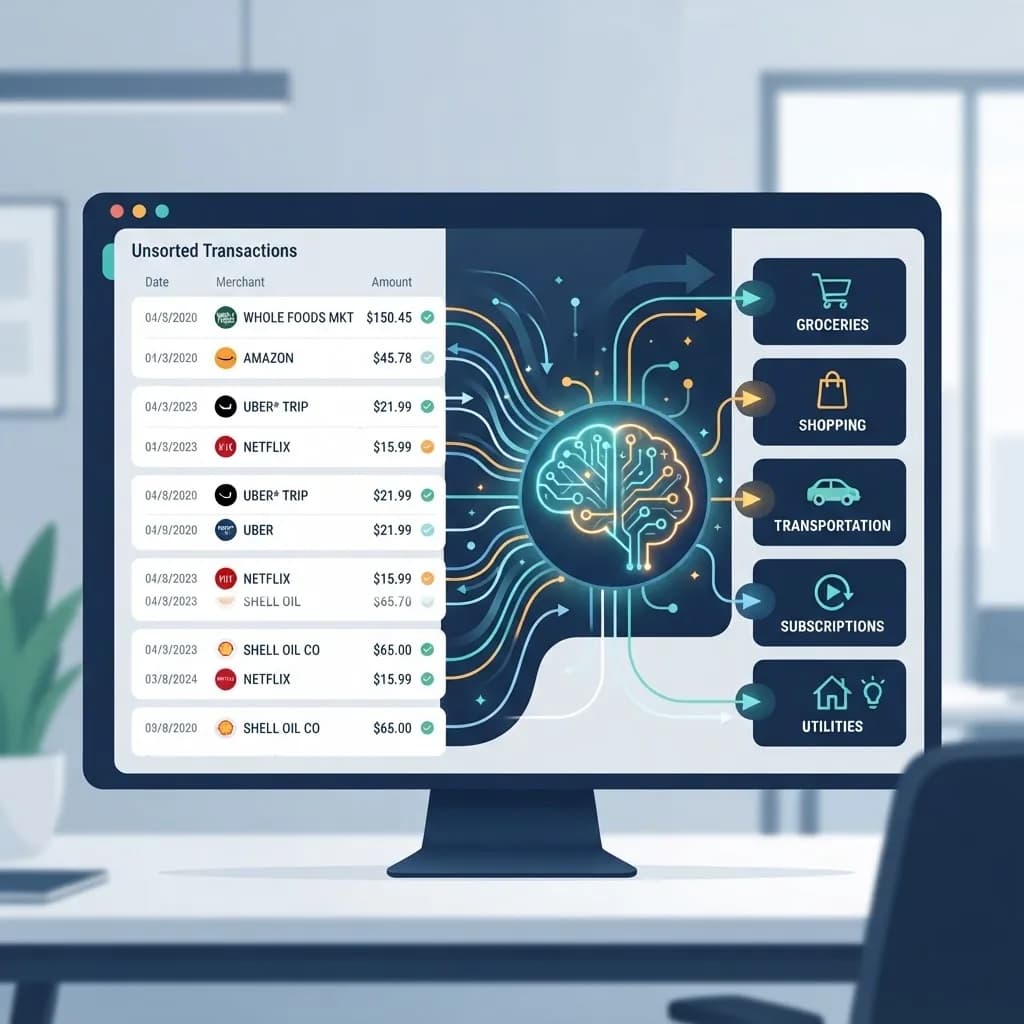
Manual transaction categorization is one of the most tedious jobs in accounting. Every swipe, transfer, and vendor payment has to be assigned to the right account, and a single misclassification can distort a financial report. AI-powered accounting software changes that by learning your patterns and coding transactions automatically. This guide explains how automated categorization works, what to look for, and which platforms lead the category.
Why Automated Transaction Categorization Matters
Categorization is the foundation of clean books. If transactions are miscoded, everything downstream suffers: profit and loss statements, tax filings, cash-flow forecasts, and budgeting. Traditionally, bookkeepers coded each line by hand or leaned on rigid rules that broke whenever a vendor name changed. AI removes most of that friction by recognizing patterns across thousands of transactions and improving as it sees corrections.
How AI Categorization Actually Works
Modern engines combine several techniques. They parse the merchant name, amount, frequency, and metadata from the bank feed, then compare the transaction to historical behavior. Machine learning models predict the most likely category, and many systems attach a confidence score. When confidence is high, the entry is coded automatically; when it is low, the transaction is flagged for human review. Crucially, every correction you make becomes training signal, so accuracy climbs over time.
Signals the Models Use
- Merchant identity: normalized vendor names, even when the raw description is messy.
- Amount and cadence: recurring charges of the same value are strong hints for subscriptions or rent.
- Historical mapping: how you or similar businesses coded the same vendor before.
- Context: the account the money moved through and any attached memo or receipt.
What to Look for in AI Accounting Software
Not every tool that claims to use AI delivers real value. When you evaluate options, weigh these criteria:
- Accuracy and learning speed: how quickly the system adapts to your corrections.
- Confidence scoring: transparency about which entries were auto-coded versus flagged.
- Bank feed coverage: reliable, direct connections to your financial institutions.
- Rules plus AI: the ability to combine deterministic rules with machine learning for predictable edge cases.
- Audit trail: a clear record of who or what changed each classification.
- Integrations: compatibility with your ledger, tax tools, and reporting stack.
Leading AI Accounting Platforms for Categorization
Several categories of tools now offer strong automated categorization. Rather than ranking a single winner, it helps to understand the archetypes.
Established Cloud Ledgers
Mainstream platforms such as QuickBooks Online and Xero have layered machine learning onto their bank feeds. They suggest categories, remember your confirmations, and handle the long tail of common small-business transactions well. For most small and mid-sized companies, these are the default starting point because the ecosystem of integrations is enormous.
Automation-First Tools
Products like Bill, Ramp, and Brex focus on spend management and bring aggressive automation to categorization, receipt matching, and policy enforcement. If a large share of your transactions are card spend and vendor bills, these tools often auto-code a very high percentage without human touch.
AI-Native Bookkeeping Services
A newer wave of platforms pairs machine learning with human bookkeepers who review only the low-confidence exceptions. This hybrid model can deliver near-hands-off books while keeping an expert in the loop for judgment calls.
Realistic Benefits and Time Savings
The strongest reason to adopt AI categorization is time. Teams routinely report that the bulk of routine transactions get coded automatically, leaving humans to focus on exceptions and analysis. Beyond speed, you gain consistency, because the model applies the same logic every time rather than relying on whichever staff member happens to be reconciling that week. Cleaner, more consistent books also make month-end close faster and audits less painful.
Limitations to Keep in Mind
AI is powerful but not infallible. New vendors, unusual one-off expenses, and ambiguous transfers can still trip up the model. That is why confidence scoring and human review matter so much: the goal is not to eliminate oversight but to concentrate it where judgment is genuinely required. Treat the AI as a tireless first-pass bookkeeper, not a replacement for financial review.
How to Roll It Out Successfully
- Start by connecting clean, well-organized bank feeds so the model learns from good data.
- Correct early misclassifications promptly; the first few weeks shape long-term accuracy.
- Define rules for predictable, high-volume vendors to remove ambiguity.
- Review the low-confidence queue on a regular cadence rather than letting it pile up.
Comparing the Approaches: Which Fits Your Business?
Choosing the right tool depends heavily on your transaction mix and team. A solo founder or small service business with a few dozen transactions a month is well served by an established cloud ledger, where the AI quietly learns from confirmations and the ecosystem of integrations is vast. A company with heavy corporate-card spend benefits more from an automation-first spend platform that auto-codes card transactions and enforces policy at the point of purchase. And a founder who wants to be almost entirely hands-off may prefer an AI-native bookkeeping service that combines machine learning with human reviewers who handle only the exceptions.
It is also worth thinking about growth. A tool that fits today may strain as volume climbs or as you add entities, currencies, or departments. The best decision balances current needs against where the business will be in a year or two, so you are not forced into a painful migration just as things get busy.
Measuring the Impact
To know whether automated categorization is actually working, track a few concrete metrics rather than relying on gut feel.
- Auto-categorization rate: the share of transactions coded without human intervention. Expect this to rise steadily as the model learns.
- Correction rate: how often you override the AI. A falling correction rate signals improving accuracy.
- Time to close: how long month-end takes now versus before. This is the metric leadership cares about most.
- Exception volume: the number of low-confidence items in the review queue, which shows where the model still struggles.
Reviewing these numbers monthly turns adoption from a leap of faith into a measurable improvement you can defend to stakeholders.
The Role of Human Review
It is tempting to imagine fully autonomous books, but the smartest teams keep a deliberate human checkpoint. The goal is not to review everything; it is to review the right things. Confidence scoring makes this efficient: high-confidence entries pass through automatically, while ambiguous ones, new vendors, unusual amounts, or first-time categories, are surfaced for a quick human decision. This division of labor captures most of the time savings while preserving the accuracy and accountability that tax authorities and auditors expect. Over time, as the model absorbs those human decisions, the exception queue naturally shrinks.
Related Services
If you are building or scaling systems around the ideas in this guide, these professional services can help:
Frequently Asked Questions
Will AI categorization work for a brand-new business with no history?
Yes, though accuracy improves with data. Early on, the software leans on patterns from similar businesses and your corrections, then personalizes quickly.
Is automated categorization safe for tax reporting?
It is, provided you keep a human review step for flagged items and maintain a clear audit trail. Many firms use AI to draft the books and an accountant to sign off.
Can I combine rules with AI?
The best setups do exactly that. Use deterministic rules for predictable vendors and let machine learning handle the messy long tail.
Conclusion
The best AI accounting software for automated transaction categorization blends accurate machine learning, transparent confidence scoring, strong bank feeds, and a sensible human-review workflow. Choose a platform that fits your transaction mix, invest a little effort in training it early, and you will reclaim hours every month while keeping your books cleaner and more consistent than manual coding ever allowed.
Enjoyed this article? Share it with others!