
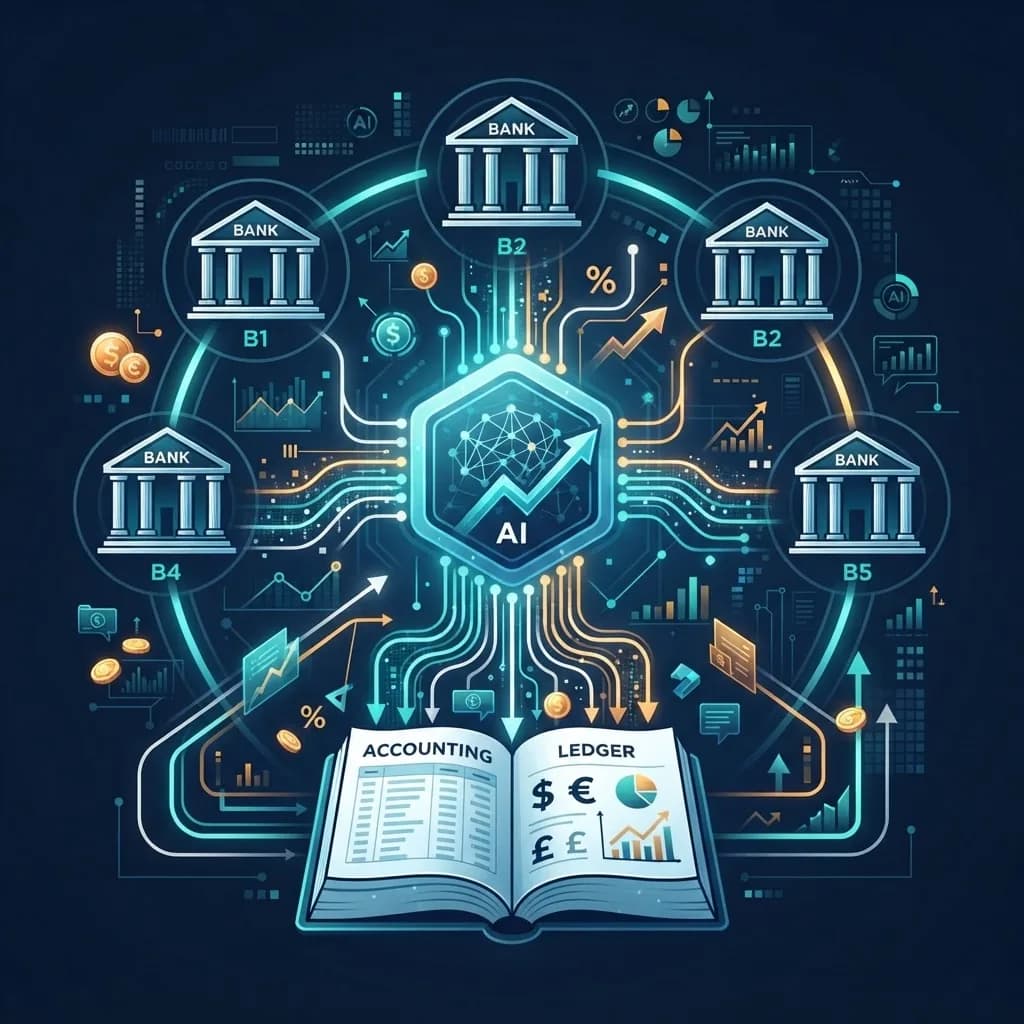
Automation in accounting is only as good as the data feeding it. That is why direct bank feed integrations are the backbone of every serious AI accounting platform. When transactions flow automatically from your financial institutions into your ledger, AI can categorize, reconcile, and analyze them in near real time. This guide covers what direct bank feeds are, why they matter, and which AI accounting platforms handle them best.
What Is a Direct Bank Feed?
A direct bank feed is a secure, automated connection between your bank or card provider and your accounting software. Instead of downloading statements and importing files, transactions appear in your ledger automatically, often daily. Feeds are typically established through banking APIs or trusted aggregation services, and they eliminate the manual, error-prone step of moving data by hand.
Why Direct Feeds Beat Manual Imports
- Freshness: data arrives continuously, keeping your books current.
- Accuracy: no fat-finger errors from manual entry or mismatched file formats.
- Automation fuel: AI needs a steady stream of clean data to categorize and reconcile effectively.
- Speed to close: reconciliation becomes a review task rather than a data-gathering marathon.
How AI Amplifies Bank Feeds
A raw feed is just data. AI is what turns it into finished books. As transactions land, machine learning models code them to the right accounts, match them against invoices and bills, and flag anything unusual. High-confidence entries are handled automatically, while ambiguous ones are queued for review. Over time, the system learns your patterns and the share of hands-off transactions climbs. The combination of live feeds and AI is what makes continuous, always-current accounting possible.
Leading AI Accounting Platforms With Strong Feeds
Several platforms have built their reputation on reliable feeds paired with intelligent automation.
QuickBooks Online
QuickBooks offers broad bank connectivity and mature machine-learning categorization. Its large integration ecosystem and familiarity make it a common default for small and mid-sized businesses that want dependable feeds plus automation.
Xero
Xero is known for clean bank feeds, strong reconciliation tools, and a rules engine that pairs well with its AI suggestions. It is especially popular internationally and with firms that value a tidy, modern interface.
Spend Management Platforms
Tools such as Ramp and Brex connect directly to card and banking data and apply aggressive automation. For businesses with heavy card spend, these platforms auto-code a large share of transactions and enforce spending policies in real time.
Bill and Payables Platforms
Accounts-payable-focused tools integrate feeds with invoice capture and approval workflows, using AI to match payments to bills and keep vendor records accurate.
What to Evaluate Before You Commit
The quality of a feed integration varies widely. Before choosing a platform, dig into these factors:
- Institution coverage: confirm your specific banks and card providers are supported with stable connections.
- Feed reliability: ask how often feeds break and how quickly they reconnect.
- Security model: look for encryption, tokenized credentials, and support for official banking APIs rather than fragile screen scraping.
- AI accuracy: evaluate how well the platform auto-categorizes and how fast it learns.
- Reconciliation tools: a good review workflow makes the automation trustworthy.
- Multi-currency and scale: important if you operate across regions or handle high volume.
Security and Compliance Considerations
Connecting your bank to software understandably raises security questions. Reputable platforms never store your banking password in plain text; they use tokenized, read-only connections through secure APIs or vetted aggregators. Look for providers that publish their security practices, support multi-factor authentication, and comply with relevant financial data regulations. A direct feed should give the software the ability to read transactions, not to move money.
Setting Up Feeds for Success
- Connect all relevant accounts so the AI sees the full financial picture.
- Establish rules for predictable, high-volume vendors to reduce ambiguity.
- Review and correct early categorizations to train the model quickly.
- Monitor feed health and reconnect promptly if a connection drops.
Bank Feeds and the Continuous Close
The biggest strategic prize that direct feeds unlock is the continuous close. In the old model, finance teams spent the first week or two of every month racing to gather data, reconcile accounts, and produce statements about a period that had already ended. With live feeds flowing into an AI-powered ledger, reconciliation happens a little every day rather than all at once. By the time the month ends, the books are nearly finished. This compresses the close from weeks to days, reduces the stress of period-end, and gives leadership numbers they can actually act on while they are still relevant.
How Feeds Differ by Business Type
The ideal feed setup varies with how a business operates. A product company with inventory needs feeds that connect not just to banks but to payment processors and possibly point-of-sale systems, so revenue and cost data arrive together. A services firm with heavy vendor spend benefits most from feeds tied into accounts-payable automation. A multi-entity or international business must prioritize platforms with broad institution coverage and solid multi-currency support, since a feed that works for one country's banks may not cover another's. Mapping your own transaction sources before you choose a platform prevents unpleasant surprises later.
Questions to Ask a Vendor
- Which of my specific banks and card providers do you support, and how stable are those connections?
- Do you use official banking APIs, or do you rely on screen scraping that breaks more often?
- How quickly does a broken feed reconnect, and will I be notified automatically?
- How does your AI handle a brand-new vendor it has never seen before?
- What audit trail do you keep for every automated categorization?
Common Pitfalls and How to Avoid Them
Even a great platform can disappoint if set up carelessly. The most frequent mistake is connecting only some accounts, which leaves the AI with an incomplete picture and produces misleading reports. Another is ignoring the low-confidence review queue until it becomes unmanageable; a little regular attention keeps the model sharp and the books clean. Teams also sometimes skip setting rules for obvious, high-volume vendors, forcing the AI to guess where a simple rule would guarantee accuracy. Finally, failing to monitor feed health means a silent disconnect can leave gaps that only surface at month-end. A brief weekly check on feed status prevents this entirely.
Key Takeaways
- Direct bank feeds are the foundation of automation, supplying the clean, continuous data that AI needs.
- The strongest platforms pair broad institution coverage with reliable connections and intelligent categorization.
- Live feeds plus AI enable a continuous close, compressing month-end from weeks into days.
- Security matters: favor tokenized, read-only connections through official banking APIs over fragile screen scraping.
- Set up feeds thoughtfully, connect all accounts, add rules, and monitor feed health, to get the most value.
Related Services
If you are building or scaling systems around the ideas in this guide, these professional services can help:
Frequently Asked Questions
Are direct bank feeds safe?
When provided by reputable platforms using tokenized, read-only connections and strong encryption, they are widely considered safe. The software can view transactions but cannot move your funds.
How often do feeds update?
Most feeds refresh at least daily, and some update multiple times per day depending on the institution and connection method.
What happens if a feed breaks?
Feeds occasionally disconnect after a bank changes its security. Good platforms notify you and provide a quick reconnection flow, and you can import a statement manually to fill any gap.
Conclusion
The best AI accounting platforms with direct bank feed integrations pair broad, reliable connectivity with intelligent automation and strong security. Live feeds supply the clean, continuous data that AI needs to categorize and reconcile, turning bookkeeping into a near-real-time process. Evaluate coverage, reliability, and security carefully, set the system up thoughtfully, and you will enjoy books that are always current and largely hands-off.
Enjoyed this article? Share it with others!