
Foundational Concepts in Density Studies
Density represents one of fundamental physical properties characterizing matter, defined as the mass per unit volume of a substance. Advanced study assignments examining densities of solids and liquids require students to understand theoretical principles underlying density calculations while developing practical laboratory skills. The relationship between mass, volume, and density provides foundational knowledge applicable across chemistry, physics, materials science, and engineering disciplines.
Different solids and liquids exhibit remarkably varied densities reflecting their molecular structure, atomic composition, and physical state. Water, despite its commonality, exhibits unusual density properties making it exceptional among liquids. Understanding density variations among substances provides insights into atomic arrangement, bonding patterns, and intermolecular forces governing physical properties. For comprehensive learning resources exploring chemistry concepts, visit Tulu E Biz.
Experimental Methodology for Measuring Solid Density
Measuring solid density requires accurate determination of both mass and volume. Students typically use analytical balances providing measurements to 0.01 or 0.001 gram precision for mass determination. Volume measurement methods vary depending on solid geometry and composition. Regular geometric solids allow calculation using length measurements and geometric formulas. Irregular solids require displacement methods where volume equals liquid volume displaced by the solid.
Advanced techniques include using graduated cylinders for liquid displacement volume measurement or employing digital volume measurement devices for increased precision. Students must recognize potential sources of measurement error including balance calibration, temperature effects on volume, and surface tension effects on liquid displacement. Careful technique development and error analysis strengthens experimental skills and scientific understanding.
Measuring Liquid Density Through Experimental Procedures
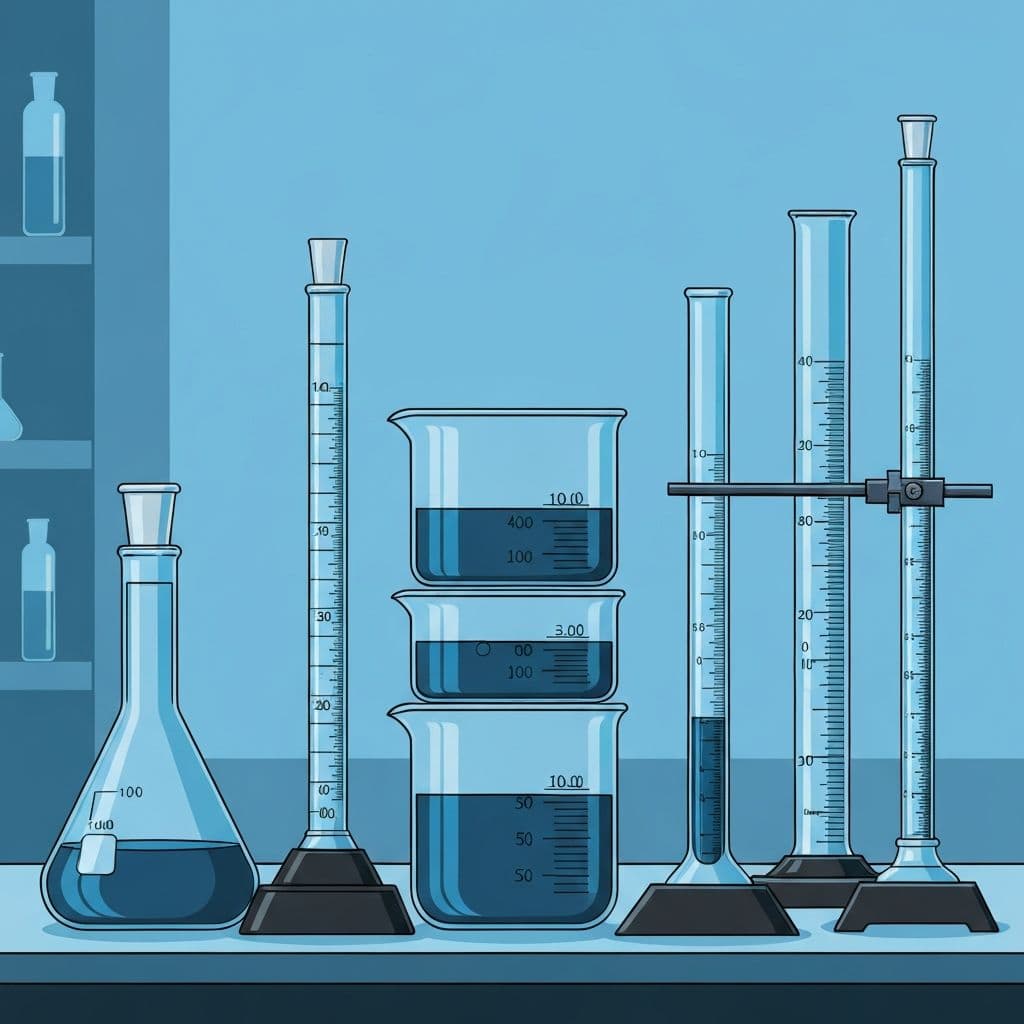
Liquid density determination typically employs mass measurement via analytical balance and volume measurement using calibrated glassware. Measuring cylinders, volumetric flasks, and burettes provide standard methods for precise liquid volume determination. Temperature considerations become crucial for liquids since density varies with temperature; experimental conditions should be recorded precisely for later interpretation.
Advanced assignments often require determining density at multiple temperatures, documenting how thermal expansion affects density values. Students calculate temperature coefficients describing density change rates with temperature change. This analysis provides insight into molecular-level phenomena and develops quantitative interpretation skills. Precise measurement techniques ensuring reproducible results represent essential competency for chemistry students.
Mathematical Calculations and Data Analysis
Density calculations follow the straightforward formula: Density = Mass / Volume. However, advanced assignments require developing competency with significant figures, unit conversions, and error propagation. Students must calculate experimental density values, compare results with literature values, determine percentage error, and analyze sources of experimental deviation.
Statistical analysis of replicate measurements develops analytical rigor. Students calculate mean values, standard deviations, and confidence intervals from multiple density determinations. This statistical treatment provides more defensible results than single measurements while quantifying measurement uncertainty. Graphical analysis representing density variation with temperature or composition develops visualization skills.
Practical Applications and Real-World Relevance
Density measurements possess tremendous practical significance across industries and applications. Materials selection in engineering often depends on density properties. Density differences enable separation techniques including flotation and density gradient centrifugation. Quality control in manufacturing frequently relies on density measurements detecting compositional variations or contamination.
Understanding density relationships contributes to environmental science, where density stratification in aquatic systems creates ecological zones supporting different organisms. Density variations in atmospheric layers explain weather phenomena and climate patterns. Medical applications employ density measurements in diagnostic procedures and pharmaceutical quality control. Recognizing these applications motivates careful experimental work and precise analysis.
Advanced Variations and Extended Investigations
Advanced study assignments often extend basic density measurements toward more complex investigations. Determining density of solutions at varying concentrations develops understanding of colligative properties and solution behavior. Measuring density of solids at different temperatures provides experimental data about thermal expansion coefficients and material properties.
Some advanced assignments examine density relationships using liquid mixtures or comparing densities of polymorphic forms where the same substance exhibits different crystalline structures with varying densities. These extensions develop deeper understanding of how molecular arrangement affects macroscopic physical properties. Students gaining competency with fundamental density measurements can confidently undertake these more sophisticated investigations.
Data Presentation and Laboratory Communication
Advanced chemistry assignments emphasize professional data presentation and clear scientific communication. Students learn to create effective tables organizing experimental data, develop graphs representing relationships between variables, and write formal laboratory reports. These communication skills prove essential for academic chemistry and professional scientific careers.
Laboratory reports should clearly document experimental procedures, present data systematically, discuss results comprehensively, and acknowledge limitations and error sources. Students who develop strong scientific communication skills communicate their understanding more effectively and receive superior evaluation of their experimental work. These skills extend far beyond chemistry courses into professional contexts.
Enjoyed this article? Share it with others!