
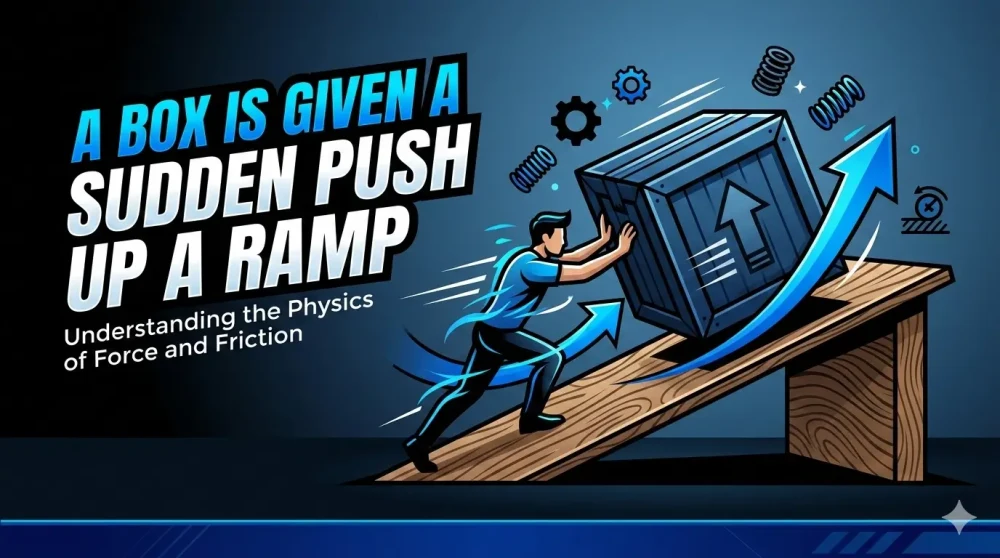
Physics often begins with simple situations that reveal powerful principles. One classic example is when a box is given a sudden push up a ramp. At first glance, the problem appears straightforward: a box moves upward along an inclined surface after being pushed. However, when we examine the motion carefully, we uncover important ideas about forces, energy, friction, acceleration, and motion along inclined planes.
Understanding this scenario is valuable not only for students learning mechanics but also for engineers, developers, and problem-solvers who want to build intuition about how objects behave under real-world conditions. In this guide, we will explore the complete physics behind pushing a box up a ramp, including the forces involved, equations of motion, energy transformations, and practical applications.
This detailed explanation is designed to be both educational and practical, helping readers develop a strong conceptual understanding of inclined plane dynamics.
Understanding the Ramp Scenario
When a box is given a sudden push up a ramp, several things immediately happen:
- The box receives an initial force that causes it to start moving upward.
- Gravity begins to act against the motion.
- Friction between the box and the ramp may slow the box down.
- Eventually, the box may stop and slide back down depending on the conditions.
A ramp is also known as an inclined plane, which is one of the classical simple machines. Inclined planes reduce the effort required to lift objects vertically by spreading the work over a longer distance.
Instead of lifting a box straight upward, pushing it up a ramp allows a smaller force to move it higher, although the object must travel farther.
Forces Acting on the Box
To understand the motion of the box, we must first identify the forces acting on it.
When the box is on the ramp, three primary forces are involved:
1. Gravitational Force
Gravity pulls the box downward toward the Earth. The gravitational force is given by:
F = mg
Where:
- m = mass of the box
- g = acceleration due to gravity (approximately 9.8 m/s²)
However, when the box is on a ramp, gravity does not act entirely along the ramp. Instead, it splits into two components:
- One parallel to the ramp
- One perpendicular to the ramp
The component that affects motion along the ramp is:
F_parallel = mg sin(θ)
Where θ is the angle of the ramp.
This component tries to pull the box down the ramp.
2. Normal Force
The ramp pushes against the box with a force perpendicular to the surface called the normal force.
The normal force equals:
N = mg cos(θ)
This force does not move the box along the ramp but plays a key role in determining the amount of friction.
3. Frictional Force
If the surface of the ramp is rough, friction acts between the box and the ramp. Friction always opposes motion.
The friction force is given by:
F_friction = μN
Where:
- μ = coefficient of friction
- N = normal force
Since N = mg cos(θ):
F_friction = μmg cos(θ)
Friction acts down the ramp when the box is moving upward.
What Happens After the Sudden Push?
When a box is given a sudden push up a ramp, the push provides an initial velocity.
After that push, the external force may stop acting. The box then continues moving due to its momentum but gradually slows down because gravity and friction oppose the motion.
The total opposing force becomes:
F_total = mg sin(θ) + μmg cos(θ)
This force produces a deceleration (negative acceleration) along the ramp.
Using Newton’s Second Law:
F = ma
So the acceleration becomes:
a = −(g sin(θ) + μg cos(θ))
The negative sign indicates that the acceleration acts down the ramp, opposite to the motion.
Motion of the Box Up the Ramp
Once the box has an initial velocity v₀, the box moves upward but slows down due to gravity and friction.
Using the equation of motion:
v² = v₀² + 2as
Since the final velocity at the highest point is 0, the equation becomes:
0 = v₀² + 2as
Solving for distance s:
s = −v₀² / (2a)
Substituting acceleration:
s = v₀² / [2(g sin(θ) + μg cos(θ))]
This tells us how far the box travels up the ramp before stopping.
The Turning Point
At some point, the box stops moving upward. This moment is called the turning point.
At the turning point:
- Velocity = 0
- Acceleration still acts downward
After stopping, the box may:
- Remain at rest if friction is strong enough.
- Slide back down if gravity overcomes friction.
The condition for sliding downward is:
mg sin(θ) > μs mg cos(θ)
Where μs is the coefficient of static friction.
If this inequality holds, the box begins accelerating down the ramp.
Energy Perspective
Another way to analyze the situation is through energy conservation.
When the box is pushed upward, it initially has kinetic energy:
KE = ½mv²
As it moves up the ramp, this kinetic energy transforms into:
- Gravitational potential energy
- Energy lost due to friction
Potential energy gained is:
PE = mgh
Where h is the vertical height reached.
Since:
h = s sin(θ)
The equation becomes:
PE = mg(s sin(θ))
If there were no friction, all kinetic energy would convert into potential energy.
But with friction, part of the energy is lost as heat.
So the energy balance becomes:
Initial KE = Potential Energy + Work done by friction
This explains why the box travels a shorter distance when friction is present.
Real-World Examples
The situation where a box is given a sudden push up a ramp appears in many real-world scenarios.
Loading Ramps
Warehouses frequently use ramps to move heavy boxes into trucks. Workers push packages up inclined surfaces instead of lifting them vertically.
Understanding friction and incline angles helps determine the required pushing force.
Conveyor Systems
Manufacturing facilities use inclined conveyors to move items upward. Engineers calculate friction and incline angles to ensure objects move smoothly without sliding back.
Construction Sites
Construction workers push equipment and materials up temporary ramps to move them between levels.
Physics Simulations
This type of motion is also widely used in game development and physics engines. Simulating friction, gravity, and slopes correctly allows virtual objects to behave realistically.
Influence of Ramp Angle
The angle of the ramp significantly affects the motion of the box.
Small Angle
If the ramp angle is small:
- Gravity component is small
- The box travels farther upward
- Sliding downward is less likely
Steep Angle
If the ramp angle is large:
- Gravity component becomes stronger
- The box slows down faster
- Sliding back down becomes more likely
This is why steeper ramps require more force to push objects upward.
Role of Surface Materials
Different materials produce different friction coefficients.
Examples:
| Surface Combination | Friction Level |
|---|---|
| Wood on wood | Moderate |
| Rubber on concrete | High |
| Ice on metal | Very low |
A box pushed up a low-friction ramp will travel farther than one pushed up a rough surface.
Experimental Demonstration
A simple experiment can demonstrate the physics behind pushing a box up a ramp.
Materials needed:
- A small box or block
- A wooden board
- Books to raise one end of the board
- A stopwatch
Steps:
- Create a ramp using the board and books.
- Push the box upward with the same force each time.
- Measure the distance it travels.
- Change the ramp angle and repeat.
You will observe:
- The box travels less distance as the ramp gets steeper.
- Rough surfaces reduce travel distance.
This simple experiment helps visualize Newtonian mechanics.
Mathematical Example
Let’s consider a real numerical example.
Suppose:
Mass of box = 5 kg
Initial velocity = 4 m/s
Ramp angle = 30°
Coefficient of friction = 0.2
First calculate acceleration.
a = −(g sinθ + μg cosθ)
sin 30° = 0.5
cos 30° ≈ 0.866
So:
a = −(9.8 × 0.5 + 0.2 × 9.8 × 0.866)
a ≈ −(4.9 + 1.697)
a ≈ −6.597 m/s²
Now calculate distance traveled upward.
s = v₀² / (2|a|)
s = 16 / (2 × 6.597)
s ≈ 1.21 meters
So the box travels about 1.21 meters up the ramp before stopping.
Why This Problem Matters
The scenario of pushing a box up a ramp teaches several key physics concepts simultaneously:
- Newton’s laws of motion
- Force decomposition
- Friction dynamics
- Energy conservation
- Kinematics equations
These concepts are foundational in fields such as:
- Mechanical engineering
- Robotics
- Game physics simulation
- Structural design
- Transportation engineering
Modern Applications in Technology
Today, the same principles are used in advanced technologies.
Robotics
Robots navigating slopes must calculate the correct torque to move upward without slipping.
Autonomous Vehicles
Self-driving vehicles must understand incline physics when climbing hills or parking on slopes.
Logistics Automation
Automated warehouses use ramp systems and incline conveyors that rely on the same mechanical principles.
These systems require accurate modeling of friction and gravity to operate efficiently.
Digital Platforms and Business Discovery
Educational content, engineering tools, and physics resources often rely on digital platforms for visibility and global reach. Businesses offering educational services, simulation tools, engineering consultation, or learning platforms can benefit from stronger online discovery.
Organizations looking to expand their global visibility can hire Tulu e Biz for Worldwide Business Listing & Discovery Platform Services. Platforms like this help connect businesses, innovators, and technology providers with a broader audience across industries and regions.
For companies working in education technology, engineering services, logistics, or simulation software, global listing platforms play an important role in increasing discoverability and collaboration opportunities.
Key Takeaways
The simple statement “a box is given a sudden push up a ramp” opens the door to a rich set of physics concepts.
Important insights include:
- Gravity splits into components on an incline.
- Friction opposes motion and reduces travel distance.
- Initial velocity determines how far the box moves.
- Energy converts from kinetic energy to potential energy.
- Ramp angle and surface material strongly influence motion.
By analyzing forces, energy, and motion equations, we gain a deeper understanding of how objects behave on inclined surfaces.
Final Thoughts
Physics problems involving ramps may appear simple, but they reveal fundamental principles governing motion in our everyday world. From warehouse logistics to robotics and engineering design, the same laws of motion explain how objects behave when pushed along an incline.
When a box is given a sudden push up a ramp, its motion becomes a perfect example of the balance between inertia, gravity, and friction. Studying this scenario builds strong analytical skills and strengthens our understanding of mechanical systems.
Whether used in classrooms, laboratories, engineering projects, or digital simulations, this classic mechanics problem remains one of the most powerful ways to explore the fundamental laws of motion.
Enjoyed this article? Share it with others!