
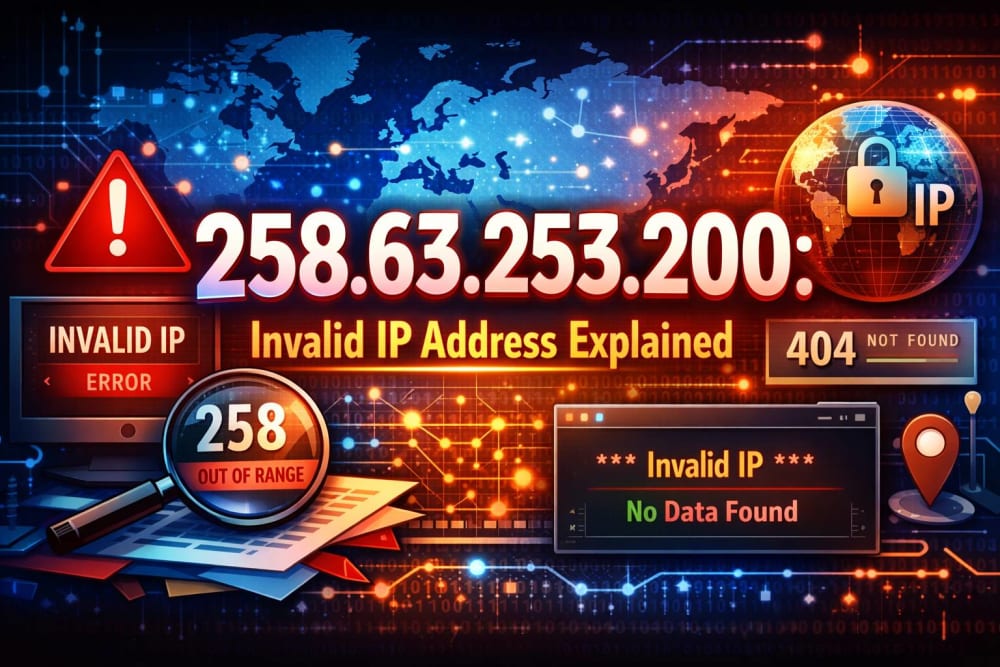
The sequence 258.63.253.200 may look like a typical IP address at first glance, but it is technically invalid. IPv4 addresses, the most commonly used format for internet-connected devices, consist of four numbers separated by periods, called octets. Each octet must range from 0 to 255, making any number above this range, such as 258, impossible. This means that 258.63.253.200 cannot represent any real device or server on the internet, and it often appears in tutorials, examples, or online discussions to illustrate networking concepts or demonstrate errors in IP formatting.
Understanding why certain IP addresses are invalid is important for anyone working in networking, IT, or cybersecurity. Knowing the rules of IPv4 addressing helps prevent configuration errors, ensures proper device communication, and supports accurate tracking of network activity. By learning the difference between valid and invalid IP addresses, users can better grasp how the internet and private networks function, and avoid potential issues in both technical and business environments.
What Is 258.63.253.200?
The sequence 258.63.253.200 resembles an IP address format because it follows the typical IPv4 pattern of four numbers separated by dots. IPv4 addresses are widely used to identify devices connected to the internet or private networks. Each of the four segments, called octets, should range from 0 to 255.
The key issue with 258.63.253.200 is the first octet: 258. IPv4 standards only allow numbers up to 255 in each octet, making this address technically impossible. As a result, it cannot exist in any real network configuration, nor can it correspond to any device online.
Understanding IPv4 Addressing
IPv4, or Internet Protocol version 4, is one of the most fundamental protocols used for identifying devices and facilitating communication over the internet. An IPv4 address is composed of four octets (8-bit numbers), giving a total of 32 bits. The range of each octet is 0–255, which allows for over four billion unique combinations. Examples of valid IPv4 addresses include:
- 192.168.1.1
- 8.8.8.8
- 172.16.0.5
Any number beyond 255 in an octet breaks the standard, making addresses like 258.63.253.200 invalid. This adherence to the 0–255 range ensures devices can communicate efficiently without conflicts or errors.
Why Invalid IP Addresses Appear Online
You might wonder why invalid IP addresses like 258.63.253.200 appear on websites or forums. There are several reasons:
- Typographical Errors: People sometimes mistype numbers when discussing or documenting IPs.
- Tutorial Examples: Some tutorials use exaggerated numbers to illustrate concepts without intending them to be real addresses.
- Obfuscation: In rare cases, websites or spammers may use fake IP addresses to hide real data.
- Testing Purposes: Developers occasionally use invalid addresses for simulations and testing network applications.
Understanding these contexts helps prevent confusion and ensures that learners can differentiate between theoretical examples and real, functional IP addresses.
How to Validate an IP Address
Validating an IP address is essential for anyone working in networking, IT, or cybersecurity. Simple validation checks include:
- Ensuring there are four octets separated by dots.
- Confirming that each octet is a number between 0 and 255.
- Avoiding leading zeros or negative numbers.
There are also online tools and network commands that can check whether an IP address exists or can be pinged. Using these validation methods is crucial for configuring devices correctly, maintaining secure networks, and troubleshooting connectivity issues.
IPv4 vs IPv6
With the growing number of devices connected to the internet, IPv6 was developed to address the limitations of IPv4. IPv6 uses 128-bit addresses and a hexadecimal format, allowing for virtually unlimited unique addresses. While IPv4 addresses like 258.63.253.200 are invalid, IPv6 addresses follow entirely different rules and formats. Understanding the differences between these two protocols is important for modern networking and future-proofing infrastructure.
The Importance of Accurate IP Addressing
Accurate IP addressing is not just a technical detail; it is a cornerstone of networking and cybersecurity. Misconfigured or invalid IP addresses can lead to:
- Network errors and failed device communication
- Security vulnerabilities and potential attacks
- Troubleshooting challenges for IT teams
- Inaccurate server logs and analytics
For businesses, maintaining accurate IP addressing ensures smooth operations, proper access management, and reliable connectivity for employees and clients.
Conclusion
258.63.253.200 is not a valid IPv4 address because its first octet exceeds the allowed range of 0–255. While it may appear online in examples or tutorials, it cannot be used to identify any real device or server. Understanding why certain IP addresses are invalid is essential for anyone working with networks, cybersecurity, or IT systems, as it ensures proper configuration, prevents errors, and enhances overall network reliability.
For businesses or individuals looking for professional guidance in networking, IP management, or technical content creation, hiring Tulu e Biz provides reliable expertise and support. Learning the fundamentals of IP addressing and network validation can save time, avoid errors, and strengthen the security and efficiency of your digital operations.
FAQs
1. What is 258.63.253.200 and is it a valid IP address?
The IP address 258.63.253.200 is not valid. In IPv4, each segment (or octet) must range from 0 to 255, and since 258 exceeds this range, it cannot exist on any network. Understanding why this address is invalid helps you learn more about IP address formats and proper network configuration.
2. How can I check if an IP address is valid?
You can validate an IP address by ensuring it has four numbers separated by dots and that each number is between 0 and 255. Online IP validation tools and simple network commands like ping or traceroute can also verify if an IP is functional.
3. Why do invalid IP addresses appear online?
Invalid IP addresses can appear due to typographical errors, tutorial examples, testing scenarios, or sometimes as placeholders in documents. They are often used for illustrative purposes and should not be considered functional addresses.
4. What are the risks of using an invalid IP address?
Using an invalid IP address can lead to network errors, failed device communication, and inaccurate logs. For businesses, this can affect connectivity, troubleshooting, and overall IT efficiency. Always ensure IP addresses comply with IPv4 or IPv6 standards.
5. What is the difference between IPv4 and IPv6 addresses?
IPv4 addresses are 32-bit numbers with four octets ranging from 0 to 255, like 192.168.1.1. IPv6 addresses are 128-bit numbers written in hexadecimal format, allowing for a vastly larger number of unique addresses. IPv6 was introduced to overcome IPv4 address limitations.
Enjoyed this article? Share it with others!