
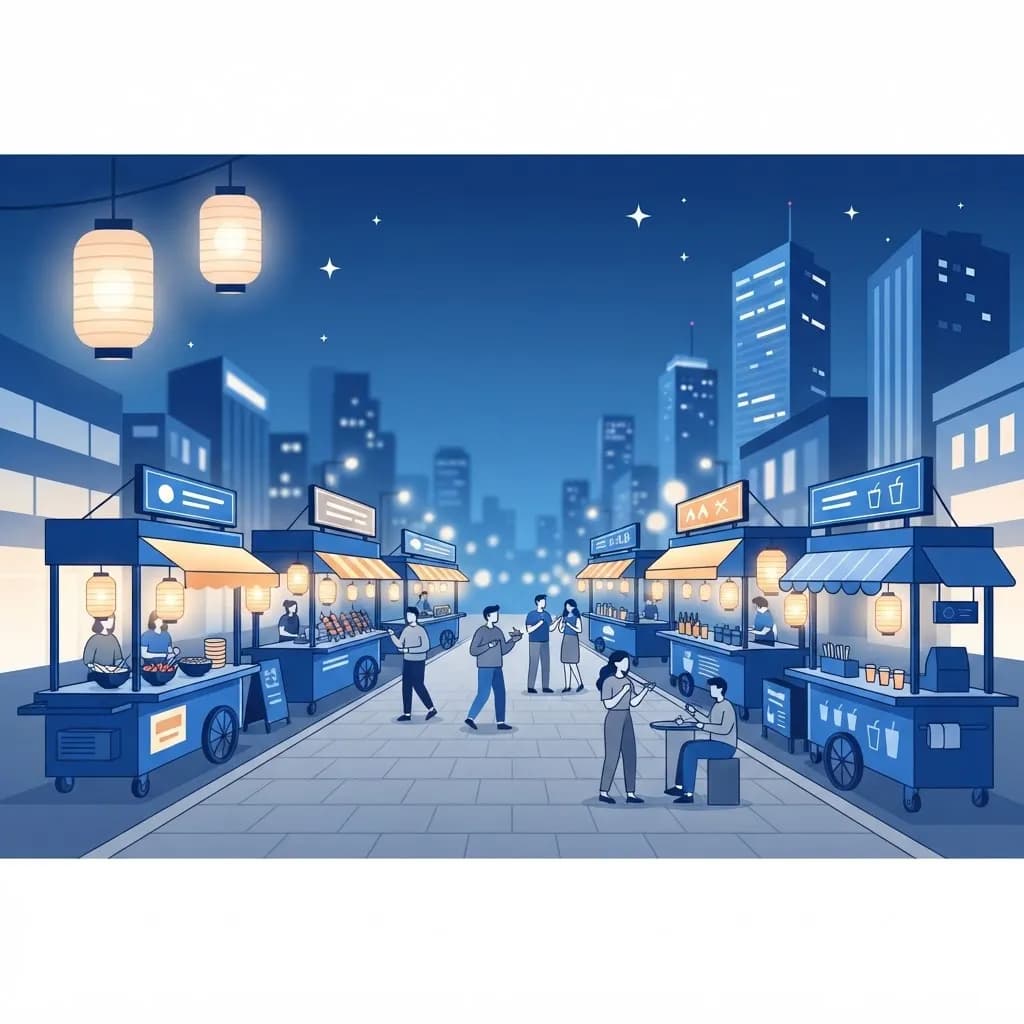
The Myeongdong Night Market is Seoul's most famous street food destination — a dazzling maze of sizzling grills, glowing stall lights, and irresistible smells in the heart of the city's busiest shopping district. Every evening, vendors line the pedestrian streets of Myeongdong selling everything from grilled lobster tails to strawberry mochi, drawing locals and travelers from around the world.
If Seoul is on your itinerary, the Myeongdong Night Market deserves a full evening. This guide explains what to eat, when to go, how much to budget, and the insider tips that separate a good visit from an unforgettable one.
What Is the Myeongdong Night Market?
Myeongdong is a compact commercial district in central Seoul, packed with cosmetics shops, fashion retailers, and department stores. Each evening — typically from late afternoon until around 10 or 11 p.m. — food carts roll into its pedestrian streets, transforming the district into one of the largest and most celebrated street food markets in South Korea.
Unlike a permanent market building, the Myeongdong Night Market is a nightly pop-up: dozens of licensed carts serving Korean classics and inventive fusion snacks, side by side with the district's regular storefronts. The result is a unique shopping-plus-eating experience where you can buy skincare, grab tteokbokki, and browse fashion all on the same block.
Who Should Visit Myeongdong Night Market?
The market appeals to nearly every kind of traveler:
- First-time visitors to Seoul who want a one-stop introduction to Korean street food culture.
- Food lovers hunting both traditional snacks and viral-worthy fusion creations.
- Shoppers combining K-beauty and fashion hauls with an evening of eating.
- Budget travelers — a filling street-food dinner costs far less than a restaurant meal.
- Content creators — the neon-lit stalls and theatrical cooking are made for the camera.
Must-Try Foods and Key Features
Korean Classics
Start with the staples: tteokbokki (chewy rice cakes in sweet-spicy gochujang sauce), hotteok (syrup-filled pancakes), odeng (fish cake skewers in warm broth), and gyeranppang (fluffy egg bread). These are the flavors of Korean street food tradition, usually priced between 3,000 and 5,000 won.
Showstopper Snacks
Myeongdong is famous for photogenic indulgences: grilled cheese lobster tails, tornado potatoes, giant king crab legs, and 32-centimeter ice cream cones. Expect these premium items to run 10,000-20,000 won.
Sweet Treats
Strawberry mochi, croissant taiyaki, sugar-dusted kkwabaegi (twisted doughnuts), and Korean egg tarts make perfect walking desserts.
Shopping Between Bites
The market runs through Korea's densest cosmetics district. Duck into shops between snacks — many stay open late and offer tourist tax refunds.
How to Plan Your Visit
A smooth Myeongdong evening follows a simple playbook:
- Arrive around 5-6 p.m. Stalls are fully set up, lines are shorter, and you'll catch both daylight and neon hours.
- Take the subway. Myeongdong Station (Line 4) or Euljiro 1-ga (Line 2) drop you steps from the action; driving is not worth it.
- Bring cash (Korean won). Most carts accept cash only; some take mobile pay, but foreign cards are hit-or-miss.
- Share everything. Portions add up fast — splitting items lets you try twice as many.
- Pace yourself street by street. Walk a full loop before committing to the big-ticket items.
Benefits of Visiting
Why does this market top so many Seoul itineraries?
- Incredible variety — dozens of distinct dishes within a few walkable blocks.
- Affordable feasting — a satisfying dinner tour costs roughly 15,000-30,000 won per person.
- No reservations, no menus — point, pay, and eat; the language barrier is minimal.
- Atmosphere — the lights, sounds, and energy are quintessential Seoul.
- Combined shopping — knock out souvenir and skincare shopping in the same trip.
Potential Challenges
Be ready for a few realities:
- Crowds — weekend evenings are shoulder-to-shoulder; weeknights are noticeably calmer.
- Tourist pricing — some showstopper items cost more than equivalent food elsewhere in Seoul.
- Limited seating — nearly everything is eaten standing or walking.
- Weather exposure — the market is outdoors; check forecasts, especially in summer monsoon season.
Best Practices and Tips
Travelers who love their Myeongdong night follow these rules:
- Watch where locals line up — long Korean-speaking queues signal the best carts.
- Carry small bills; vendors appreciate exact change during rush hours.
- Keep a hand free and dispose of skewers in cart trash bags to keep streets clean.
- Visit on a weeknight in spring or fall for the best weather-to-crowd ratio.
Real-World Example
A typical evening: two travelers arrive at 5:30 p.m., start with tteokbokki and odeng (7,000 won), split a grilled lobster tail (15,000 won), browse two cosmetics shops, then finish with hotteok and a strawberry mochi (6,000 won). Total food spend: about 28,000 won — under $22 — for a progressive dinner they'll talk about for years.
The market is also a masterclass in small-business marketing: the most successful carts have signature items, eye-catching presentation, and social media fame driven by visitor videos. It's the same playbook any food business can apply with professional video production and social media management — visual storytelling sells food.
Why Myeongdong Night Market Matters
Street food markets like Myeongdong preserve culinary tradition while constantly inventing new dishes, giving small vendors a stage that can launch national food trends. For Seoul, the market is a tourism engine; for visitors, it's the most delicious crash course in Korean food culture available anywhere.
Food and travel businesses worldwide study this model — combining destination experience with strong visual branding. If you run a food brand and want that kind of pull online, a well-built site from a website design team paired with smart digital marketing is the closest thing to a Myeongdong crowd.
Frequently Asked Questions
What time does Myeongdong Night Market open?
Food carts generally begin setting up in the late afternoon, around 4-5 p.m., with the market in full swing from 6 p.m. until roughly 10-11 p.m.
How much money should I budget for the night market?
Budget 15,000-30,000 won (roughly $12-25 USD) per person for a satisfying food tour. Add more if you want premium items like king crab or lobster.
Do Myeongdong street vendors accept credit cards?
Most carts are cash-preferred, and foreign cards often aren't accepted. Bring Korean won in small denominations; ATMs and currency exchanges are plentiful in the district.
Is Myeongdong Night Market open every day?
Vendors operate most evenings year-round, though lineups thin during harsh weather and major holidays. Weeknights offer smaller crowds than weekends.
Conclusion
The Myeongdong Night Market packs Seoul's energy, flavor, and shopping into a single unforgettable evening. Come hungry, bring cash, share generously, and let the glowing stalls guide your route — it's street food at its absolute best.
And if the market inspires your own food venture, start it right with professional content writing that makes your story as appetizing as your menu.
Enjoyed this article? Share it with others!