
A well-built marketing vendor evaluation report prompt turns a messy, opinion-driven vendor decision into a structured, defensible comparison. If you are choosing between agencies, martech platforms, or freelance partners, the prompt you feed your AI assistant determines whether you get generic filler or a genuinely useful report.
Most vendor selections fail for the same reason: the criteria were never written down. Teams compare pitch decks, favor whoever presented last, and discover misalignment three months into the contract.
This guide provides a complete, copy-ready prompt plus the scoring framework behind it, so your evaluation report holds up in front of finance, legal, and leadership.
What Is a Marketing Vendor Evaluation Report?
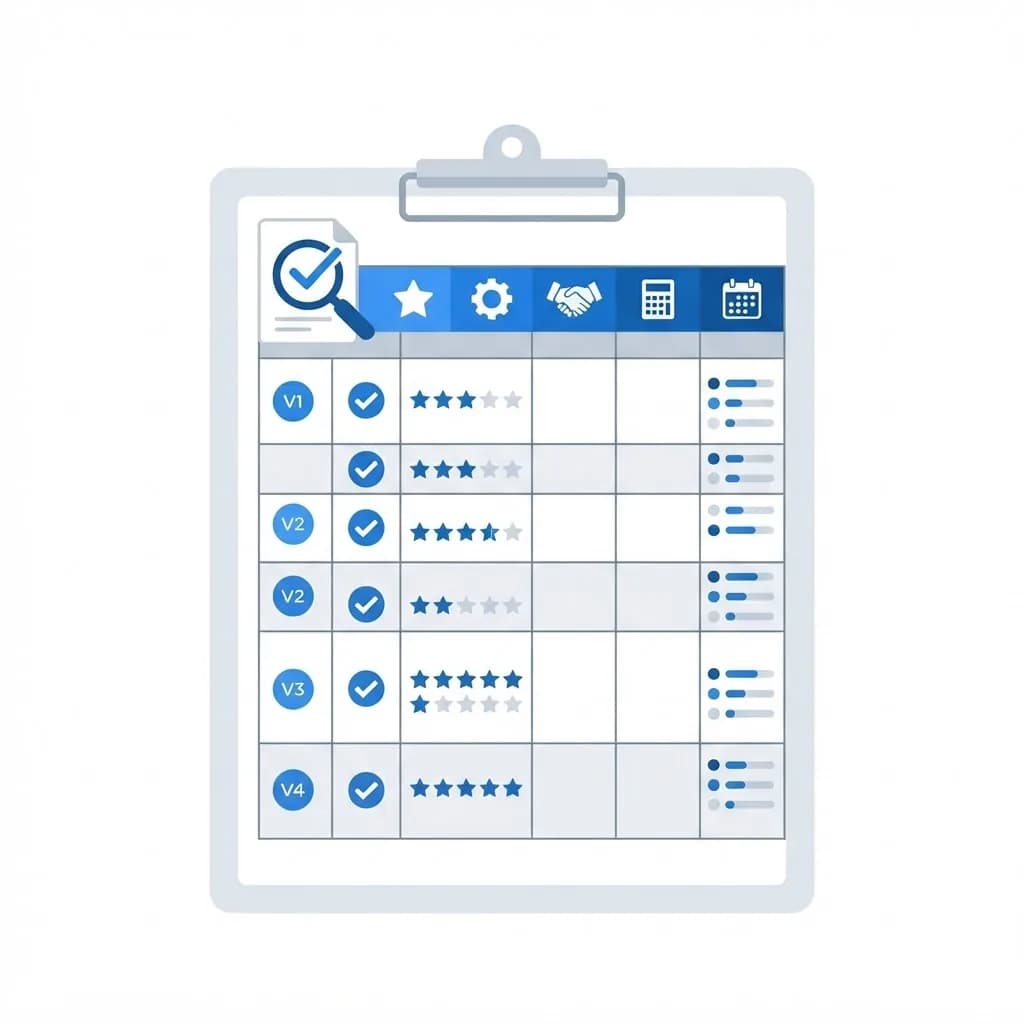
A marketing vendor evaluation report is a structured document that scores potential vendors against predefined criteria and recommends one with clear reasoning. It typically covers capability, cost, cultural fit, risk, and expected return.
The report is not a summary of sales pitches. It is an analytical comparison where every vendor is measured on identical dimensions using the same evidence standards.
The value comes from weighted, criteria-based scoring. When you assign weights before seeing proposals, you prevent the common trap of retroactively justifying a preferred vendor.
Who Needs This Prompt?
Anyone accountable for marketing spend decisions benefits from a repeatable evaluation process.
- Marketing directors selecting agencies for retainer or project work.
- Procurement teams requiring documented justification for contract approval.
- Startup founders comparing freelancers, studios, and platforms on limited budgets.
- Operations leads consolidating an overlapping martech stack.
- Consultants advising clients on vendor selection and negotiation.
Key Components of a Strong Prompt
Explicit Role and Output Format
Tell the model who it is and exactly what structure to produce. Vague prompts yield essays; specific prompts yield scored tables. Always request a summary table, per-vendor analysis, risk register, and a single recommendation with rationale.
Weighted Evaluation Criteria
Define six to eight criteria with percentage weights totaling 100. Typical categories include relevant capability, proven results, pricing and total cost of ownership, team and communication, technical integration, references, and contract flexibility.
Evidence Requirements
Instruct the model to distinguish vendor claims from verified evidence and to flag any unsupported assertion. This single instruction dramatically improves report quality and prevents marketing language from inflating scores.
Risk and Exit Analysis
Ask explicitly for switching costs, data portability, contract lock-in, and dependency risk. These factors rarely appear in sales conversations but frequently determine whether a partnership becomes painful later.
How to Use the Prompt
Follow this sequence to produce a report you can actually present.
- List your finalist vendors, ideally three to five, and gather their proposals and pricing.
- Define your criteria and weights before reading proposals to avoid bias.
- Paste the prompt below, then attach or paste each vendor's materials.
- Review the generated scores and challenge any rating you cannot trace to evidence.
- Fill evidence gaps with reference calls and follow-up questions to vendors.
- Rerun the analysis with the new information for a final scored report.
- Present the summary table, the recommendation, and the top three risks.
Here is the prompt itself. Copy it directly:
Prompt: "Act as a senior marketing procurement analyst. Produce a Marketing Vendor Evaluation Report comparing the vendors I provide. Use these weighted criteria: relevant capability 25 percent, proven results and case evidence 20 percent, total cost of ownership 20 percent, team quality and communication 15 percent, technical integration and data access 10 percent, contract flexibility and exit risk 10 percent. For each vendor, score every criterion from 1 to 5, multiply by weight, and show the weighted total. Output in this order: (1) executive summary of no more than 150 words, (2) a comparison table of all vendors and weighted scores, (3) a short analysis of each vendor with strengths, weaknesses, and any unverified claims explicitly flagged, (4) a risk register listing the top five risks with likelihood and mitigation, (5) a final recommendation with reasoning and the conditions that would change it, (6) ten follow-up questions to ask the leading vendor before signing. Never invent data. If information is missing, state exactly what is missing and how to obtain it."
Benefits of a Structured Evaluation
Formalizing vendor selection pays off well beyond the initial decision.
- Removes personality bias and last-presenter advantage from the choice.
- Creates documentation that satisfies procurement and audit requirements.
- Surfaces hidden costs like onboarding, integration, and data migration early.
- Produces sharper negotiation leverage through documented comparisons.
- Establishes a reusable framework, making future selections much faster.
Potential Challenges
Structured evaluation has failure modes worth anticipating.
- AI-generated scores can look authoritative while resting on vendor marketing claims.
- Poorly chosen weights simply encode existing bias in a spreadsheet.
- Over-engineering the process delays decisions past the point of usefulness.
- Qualitative factors like team chemistry resist numerical scoring.
Best Practices and Tips
A few disciplines keep the report honest.
- Lock criteria and weights before reviewing any proposal, and record the decision.
- Require at least two verifiable references per finalist and actually call them.
- Score total cost of ownership over three years, not just the first invoice.
- Run a small paid pilot before a long contract when evaluating AI-driven marketing services or complex platforms.
Real-World Example
A B2B software company needed a demand-generation agency and had three finalists. The cheapest quoted 8,000 dollars monthly, the mid-tier 14,000, and the premium option 22,000. Leadership leaned toward the cheapest option purely on price.
Running the weighted evaluation changed the picture. The cheapest vendor scored poorly on technical integration because it would not grant direct access to ad accounts, creating serious data-portability risk. The premium vendor scored highest on capability but poorly on total cost given the company's stage.
The mid-tier vendor won on weighted total, and the risk register surfaced a needed contract change: full account ownership retained by the client. That single clause, discovered through structured analysis, protected years of campaign history.
Why It Matters
Marketing vendor decisions commit real money and, more importantly, time. A bad agency fit can waste two or three quarters — often more costly than the fees themselves.
A documented evaluation also protects you internally. When results take time to materialize, being able to show a rigorous selection process preserves credibility with leadership.
Frequently Asked Questions
How many vendors should I evaluate?
Three to five finalists is the practical range. Fewer gives no real comparison, while more creates analysis fatigue and slows decisions without improving outcomes meaningfully.
What weight should price receive?
Most organizations land between 15 and 25 percent for total cost of ownership. Weighting price higher tends to select vendors that cost more in rework and switching later.
Can AI do the whole evaluation for me?
AI structures, scores, and drafts efficiently, but it cannot verify claims or judge team chemistry. Treat the output as a rigorous first draft that you validate with reference calls.
How often should I re-evaluate existing vendors?
Review performance quarterly against agreed KPIs and run a full re-evaluation annually or before any renewal. Regular review keeps incumbents accountable without constant churn.
Conclusion
A strong marketing vendor evaluation report prompt gives you weighted scoring, flagged assumptions, a risk register, and a clear recommendation — everything a real decision requires. Define criteria first, demand evidence, and never let a polished pitch substitute for verification.
Once you have selected a partner, make sure your own infrastructure can support the work through reliable website maintenance and support so campaigns never stall on technical debt.
Enjoyed this article? Share it with others!