Most brands do not have a marketing problem. They have a coordination problem. The SEO work says one thing, the paid ads say another, the email list hears a third message, and the website looks like it belongs to a different company entirely.
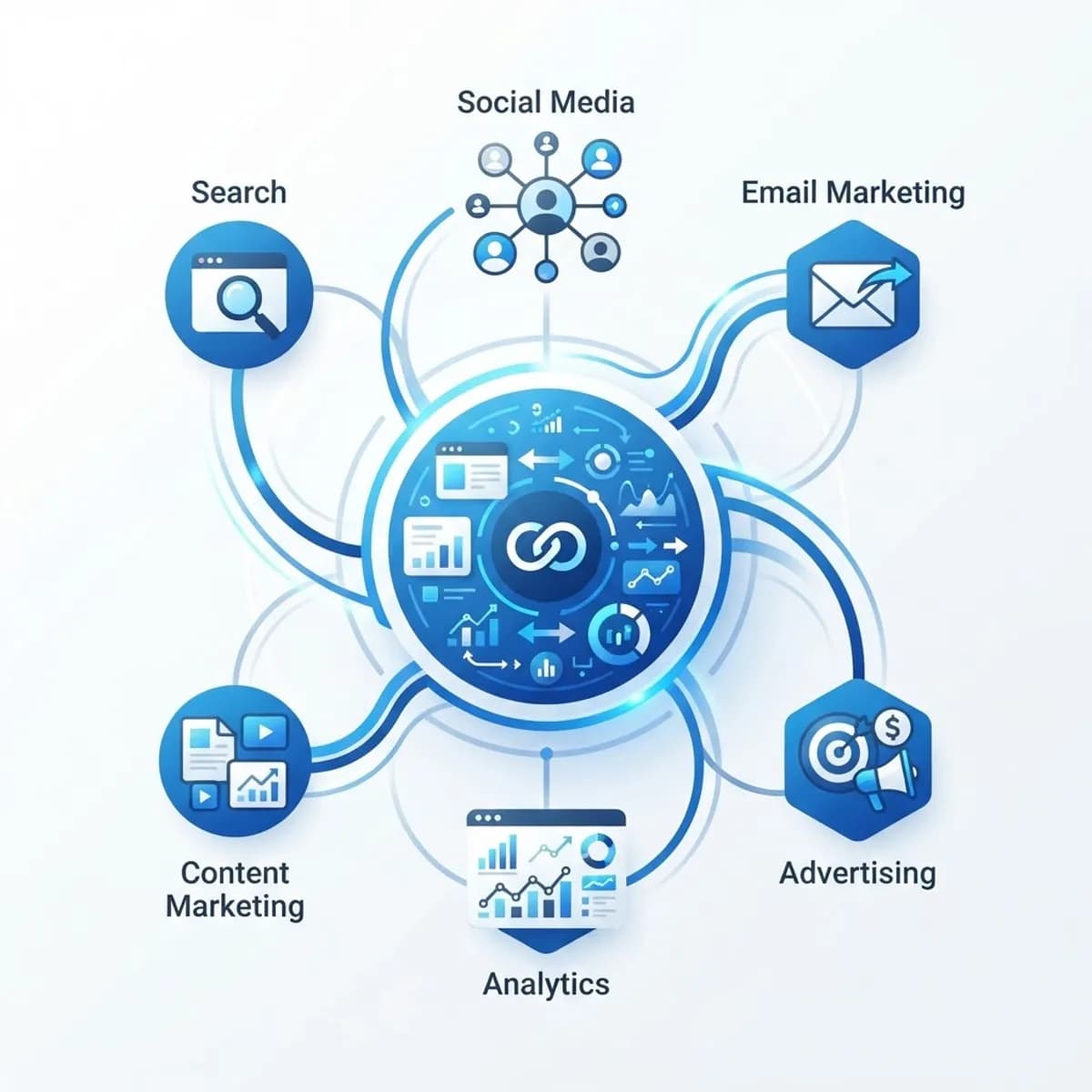
Integrated digital marketing is the fix. Instead of running channels as separate projects with separate goals, you run one strategy that every channel serves. The message stays consistent, the data flows into one place, and each channel makes the others cheaper and more effective.
This guide breaks down what integration actually looks like in practice, who benefits most from it, how to build it step by step, and the mistakes that quietly drain budgets along the way.
What Is Integrated Digital Marketing?
Integrated digital marketing is the practice of planning, executing and measuring all your online channels as a single connected system. Search, paid media, social, email, content and your website share the same positioning, the same audience definitions and the same success metrics.
The word that matters here is compounding. In a siloed setup, a blog post is just a blog post. In an integrated setup, that same post feeds an email newsletter, becomes three social posts, gets tested as ad copy, and captures search demand for months. One asset, five jobs.
Integration is not about using more tools or being on every platform. Plenty of well-integrated brands run only three channels. It is about making sure whatever channels you do run point at the same destination and speak with the same voice.
Who Needs Integrated Digital Marketing?
Any business with more than one active marketing channel already needs some level of integration. The need becomes urgent when different people or agencies own different channels without a shared plan.
- Growing small businesses that added channels one at a time and now have no unified view of what works.
- E-commerce brands where product pages, paid shopping ads, email flows and social proof all influence a single purchase decision.
- B2B and service companies with long sales cycles, where a lead touches content, retargeting and email over several weeks.
- Multi-location businesses balancing a national brand message with local search visibility.
- Companies mid-rebrand that need every touchpoint updated at once instead of over six ragged months.
Key Features of an Integrated Approach
One Positioning, Everywhere
A single sentence defines who you serve and why you are the better choice. That sentence shapes ad headlines, meta descriptions, email subject lines and the hero section of your homepage. When a prospect moves from an Instagram ad to your site, nothing feels like a bait and switch.
Shared Audience and Data Layer
Audiences built from real behaviour, not guesswork. Site visitors feed retargeting lists. Email subscribers become lookalike sources. Analytics, CRM and ad platforms are wired together so you can trace a closed deal back to its first touch.
A Website Built as the Hub
Every channel eventually sends traffic to your site, which makes it the single highest-leverage asset you own. Slow pages, confusing navigation or weak forms waste spend on every channel simultaneously. Investing in solid website design and user experience raises the ceiling on results everywhere else.
Content That Is Reused Deliberately
Nothing is created for one placement only. A customer interview becomes a case study, a short video, a set of social graphics and three email sends. Strong content writing and editorial planning is what makes this repurposing feel intentional rather than recycled.
How to Get Started With Integration
You do not need to rebuild everything at once. Integration works best as a sequence, where each step makes the next one easier and cheaper.
- Audit what you already run. List every channel, who owns it, what it costs, and what it is supposed to achieve. Overlaps and orphaned channels usually surface within an hour.
- Write your positioning in one sentence. If your team cannot agree on it, no channel will express it clearly.
- Fix the destination first. Tighten your landing pages, page speed and forms before increasing traffic to them.
- Connect your measurement. Set up conversion tracking, consistent UTM conventions and one dashboard everyone actually looks at.
- Choose two or three core channels. Pick where your buyers genuinely spend attention, then commit properly instead of spreading thin.
- Build a shared content calendar. Plan campaigns, not posts, so each theme runs across search, social, email and paid together.
- Review monthly, adjust quarterly. Short review loops for tactics, longer ones for strategy.
Benefits You Can Actually Measure
Integration is not a soft branding exercise. The gains show up in cost per acquisition, conversion rate and team hours saved.
- Lower acquisition costs because organic visibility and warm audiences reduce reliance on cold paid traffic.
- Higher conversion rates when the message a visitor clicked matches the page they land on.
- Faster production since one research and creative cycle supplies multiple channels.
- Clearer decisions because attribution spans the full journey instead of crediting the last click.
- Stronger brand recall from repeated, consistent exposure across platforms.
Potential Challenges
Integration sounds obvious on a slide and gets messy in practice. Knowing the friction points in advance saves months.
- Internal silos. When the social lead and the SEO lead report to different managers with different targets, alignment stalls.
- Messy data. Duplicate tracking, inconsistent UTMs and disconnected CRMs make reporting untrustworthy.
- Impatience. Organic search and content need months to compound, while paid shows results in days. Mixed timelines cause premature budget cuts.
- Tool sprawl. Buying platforms instead of solving process problems adds cost without adding clarity.
Best Practices and Tips
The teams that integrate successfully tend to follow a few unglamorous habits consistently.
- Keep a living brand and messaging document that every freelancer, agency and internal hire reads on day one.
- Standardise visual identity across channels. Consistent graphic design and creative assets make campaigns recognisable within a scroll.
- Run one primary campaign theme per quarter across all channels rather than five competing ideas.
- Protect your owned channels. Email and your website are the only audiences no algorithm can take from you, which is why email marketing automation deserves real attention.
Real-World Example
Consider a 12-person accounting firm running disconnected marketing. A freelancer posted on LinkedIn, an agency ran search ads to the homepage, and the blog had not been updated in a year. Leads arrived but nobody could say from where, and cost per lead kept climbing.
The firm switched to an integrated plan built around one theme per quarter, starting with year-end tax planning for small business owners. They published four in-depth guides, rebuilt the landing page to match the ad copy, sent a five-email sequence to their existing list, and retargeted guide readers with a consultation offer. Within two quarters, cost per qualified lead dropped by roughly a third, and organic traffic became the second-largest source of consultations. Nothing exotic happened. The channels simply stopped working against each other.
Why It Matters
Buyer journeys have gotten longer and messier. Someone may find you through a search result, forget you, see a video weeks later, ask a chatbot for a recommendation, then finally click an email. Integrated digital marketing is what makes that fragmented path feel like one coherent conversation.
There is also a defensive argument. Platform costs rise, algorithms shift, and search results now surface AI-generated summaries. Brands that depend on a single channel are exposed. Brands with connected channels and owned audiences absorb the shock and keep growing.
Frequently Asked Questions
How is integrated digital marketing different from regular digital marketing?
Regular digital marketing describes the channels you use. Integrated digital marketing describes how those channels connect. The difference is a shared strategy, shared audience data and shared measurement rather than parallel campaigns run in isolation.
How many channels do I need to be integrated?
Two is enough to start. Most small and mid-sized businesses do best with three well-run channels plus a strong website. Adding channels before the existing ones are aligned usually reduces overall performance.
How long before I see results?
Paid channels and email flows can show measurable improvement in two to four weeks, mainly from better message match. Search and content compounding typically becomes visible between month three and month six, then keeps building.
Can a small team handle integrated marketing?
Yes, provided you narrow the scope. Small teams win by running fewer, deeper campaigns and by reusing every asset several times. The trap is trying to match the channel count of a company ten times your size.
Conclusion
Integrated digital marketing is less about doing more and more about making everything you already do point in the same direction. Align your message, fix your website, connect your data, and plan campaigns instead of posts. The channels stop competing and start compounding.
If your current setup feels scattered, start with one audit and one quarterly theme. When you are ready to build the technical and creative foundation properly, explore professional digital marketing support and grow from a plan rather than a guess.
Enjoyed this article? Share it with others!