
Organic traffic is one of the most valuable assets a business can build online. Unlike paid advertising, which stops generating visitors when spending ends, organic traffic can provide a consistent flow of qualified prospects over the long term.
However, many businesses experience a frustrating challenge at some point in their SEO journey: traffic begins to decline.
A website that once generated strong search visibility may suddenly lose rankings, attract fewer visitors, and produce fewer leads. For organizations that depend heavily on search engines, even a moderate drop in traffic can significantly affect revenue and growth.
When traffic declines occur, businesses often react by publishing more content, increasing marketing budgets, or launching new SEO initiatives. While these efforts may help, they often fail to address the underlying reasons behind the decline.
The first step toward recovery is understanding what changed.
This is where a website audit becomes essential.
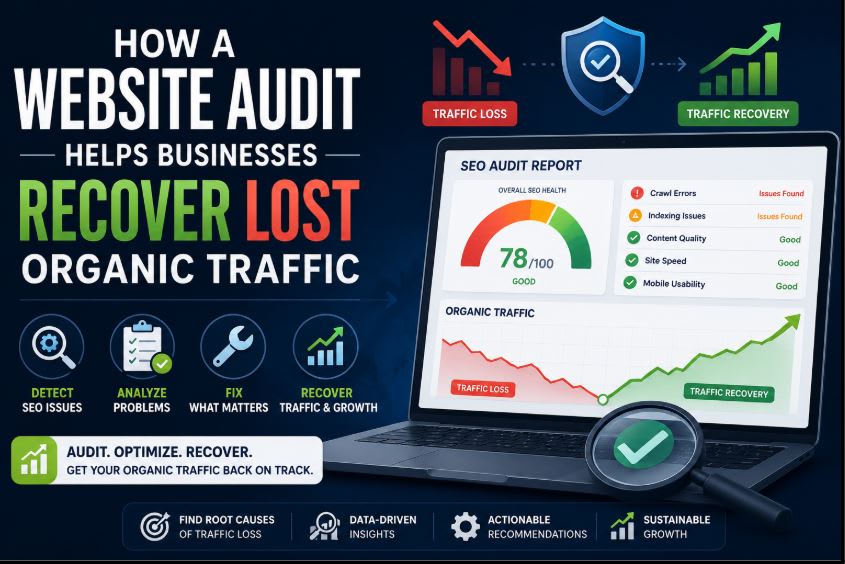
A comprehensive website audit helps identify technical issues, content weaknesses, user experience challenges, and structural problems that may be causing traffic losses. Instead of relying on assumptions, businesses gain clear data that supports informed decision-making and effective recovery strategies.
Why Organic Traffic Declines Happen
Organic traffic rarely declines without a reason.
Search engines continuously evaluate websites based on hundreds of ranking factors. Changes to these factors, along with changes within the website itself, can affect search visibility.
Common causes of traffic loss include:
- Technical SEO problems
- Algorithm updates
- Content quality issues
- Increased competition
- Site migrations
- Indexing errors
- Poor user experience
- Internal linking problems
Many of these issues remain hidden until a website audit uncovers them.
Understanding the cause of traffic loss is critical because recovery strategies vary depending on the underlying problem.
Why Guessing Is Dangerous
When rankings decline, businesses often make assumptions.
Some blame algorithm updates.
Others assume competitors are outranking them.
Some immediately invest in link building or content creation.
While these actions may seem logical, they can waste valuable time and resources if they do not address the actual problem.
A website audit eliminates guesswork.
Instead of relying on assumptions, businesses receive objective insights into:
- Website health
- Technical performance
- Content quality
- SEO weaknesses
- Growth opportunities
This data-driven approach increases the likelihood of successful recovery.
The Role of Technical SEO in Traffic Recovery
Technical SEO forms the foundation of search visibility.
Even high-quality content can struggle to rank if search engines cannot properly crawl, understand, or index a website.
A website audit evaluates critical technical elements such as:
Crawlability
Can search engines access important pages?
Indexation
Are valuable pages appearing in search results?
Site Speed
Does performance meet user expectations?
Mobile Optimization
Does the website function effectively across devices?
Redirect Management
Are redirects creating unnecessary complications?
Technical problems often cause significant ranking losses.
Identifying and correcting these issues can help restore visibility and improve organic performance.
Identifying Indexing Problems
Indexing issues are among the most common causes of unexpected traffic declines.
Important pages may disappear from search results because of:
- Incorrect noindex tags
- Canonicalization errors
- Sitemap issues
- Crawl restrictions
Businesses frequently discover through audits that high-value pages are no longer being indexed correctly.
Without visibility into indexing status, these problems can persist for months.
A website audit helps ensure that search engines can properly discover and rank important content.
Understanding the Impact of Algorithm Updates
Search engine algorithms evolve constantly.
Major updates often reward websites that provide better experiences while reducing visibility for websites with quality issues.
A website audit helps businesses evaluate factors commonly affected by algorithm updates, including:
- Content quality
- User experience
- Website authority
- Technical health
- Mobile performance
Instead of reacting blindly to updates, organizations can use audit findings to align their websites with current SEO best practices.
Content Decay and Organic Traffic Loss
Content that performs well today may not perform well forever.
Over time, content can become outdated, less relevant, or less competitive.
Common content-related issues include:
- Outdated information
- Weak keyword targeting
- Thin content
- Duplicate content
- Missing topical coverage
A website audit identifies underperforming content and highlights opportunities for improvement.
Refreshing and expanding content often plays a major role in traffic recovery strategies.
How Competitor Growth Affects Rankings
Traffic losses do not always result from internal problems.
Competitors may improve their own SEO efforts and capture market share.
A website audit helps businesses evaluate:
- Competitive content gaps
- Keyword opportunities
- Search visibility trends
- Industry benchmarks
This analysis provides valuable context and helps organizations understand whether traffic declines stem from website issues or increased competition.
Why Internal Linking Matters for Recovery
Internal links help search engines discover content and understand relationships between pages.
Poor internal linking structures can weaken rankings by:
- Limiting authority distribution
- Creating orphan pages
- Reducing crawl efficiency
A website audit evaluates internal linking performance and identifies opportunities to strengthen website structure.
In many cases, internal linking improvements contribute significantly to traffic recovery.
Recovering Traffic After Website Redesigns
Website redesigns can unintentionally damage SEO performance.
Common redesign-related issues include:
- Missing redirects
- URL changes
- Lost content
- Broken navigation
- Indexation problems
Traffic declines frequently occur after redesigns because SEO considerations are overlooked during implementation.
A website audit helps identify these issues and develop corrective actions.
Organizations that conduct audits after redesigns often recover traffic more quickly.
Why User Experience Influences Search Visibility
Search engines increasingly prioritize user experience.
Visitors who encounter poor experiences may leave quickly, reducing engagement signals that support rankings.
A website audit evaluates factors such as:
- Navigation
- Mobile usability
- Page speed
- Content accessibility
Improving these elements helps create stronger experiences for both users and search engines.
Using Website Audits to Prioritize Recovery Efforts
Traffic recovery often involves multiple opportunities for improvement.
However, not all issues carry equal importance.
A website audit helps businesses prioritize actions based on:
- SEO impact
- Business value
- Resource requirements
- Implementation difficulty
This ensures that recovery efforts focus on the most important issues first.
Why Enterprise Websites Need Specialized Traffic Recovery Strategies
Large organizations often face additional complexity.
Enterprise websites may contain:
- Thousands of pages
- Multiple subdomains
- International content
- Complex site architectures
Traffic declines can affect large portions of these websites simultaneously.
Many organizations work with an enterprise SEO agency to conduct detailed audits and develop recovery strategies tailored to enterprise-scale environments.
Because of their complexity, enterprise websites often require specialized expertise during the recovery process.
Budgeting for Traffic Recovery
Recovering lost traffic may require investments in:
- Technical SEO
- Content optimization
- Development resources
- User experience improvements
Businesses frequently struggle to estimate these costs.
A website audit provides the information necessary to understand recovery requirements and allocate budgets effectively.
Organizations often use an SEO cost calculator after completing an audit to forecast investment needs and prioritize initiatives.
This helps ensure that recovery efforts remain financially sustainable.
Why Ongoing Website Audits Prevent Future Traffic Losses
One of the most important lessons businesses learn after traffic declines is that prevention is easier than recovery.
Regular website audits help organizations:
- Monitor technical health
- Identify emerging issues
- Maintain content quality
- Adapt to algorithm changes
By detecting problems early, businesses reduce the likelihood of future traffic losses and maintain stronger search visibility.
Signs Your Website Needs an Audit Immediately
Several warning signs indicate that a website audit should be prioritized:
- Sudden traffic declines
- Ranking losses across multiple keywords
- Reduced lead generation
- Increased crawl errors
- Lower engagement metrics
- Traffic drops after redesigns or migrations
Ignoring these signals often allows problems to worsen over time.
A website audit provides the visibility needed to understand what is happening and how to respond.
Building a Long-Term Traffic Recovery Strategy
Traffic recovery should not focus solely on restoring previous performance.
It should also strengthen the website for future growth.
Effective recovery strategies often include:
- Technical improvements
- Content enhancements
- Internal linking optimization
- User experience upgrades
- Ongoing monitoring
A website audit serves as the foundation for these initiatives by providing accurate insights into current conditions and future opportunities.
Conclusion
Organic traffic declines can be frustrating, costly, and difficult to diagnose without the right information.
While businesses often assume that algorithm updates or increased competition are responsible, the true causes are frequently hidden within the website itself.
A website audit helps uncover technical issues, content weaknesses, indexing problems, and user experience challenges that may be limiting search visibility.
Whether you're starting with a free SEO website audit, working alongside an enterprise SEO agency, or forecasting investments through an SEO cost calculator, the audit process provides the clarity needed to make informed decisions and recover lost traffic effectively.
Businesses that rely on data rather than assumptions are far more likely to restore rankings, regain visibility, and achieve sustainable long-term SEO growth.
Frequently Asked Questions
1. Can a website audit help recover lost organic traffic?
Yes. A website audit identifies technical, content, and SEO issues that may be causing ranking and traffic declines.
2. What causes sudden drops in organic traffic?
Common causes include algorithm updates, indexing issues, technical SEO problems, content decay, and increased competition.
3. How often should businesses perform a website audit?
Most businesses should conduct audits every 6–12 months, while larger websites often benefit from quarterly audits.
4. Do website redesigns affect organic traffic?
Yes. Poorly managed redesigns can create technical issues that negatively impact rankings and search visibility.
5. Why is a website audit important before investing in SEO recovery?
An audit provides clear insights into the root causes of traffic loss, ensuring recovery efforts focus on the most impactful improvements.
Enjoyed this article? Share it with others!